




Do welding robot for steel structures meet ISO 3834-2 requirements out of the box or only after process qualification?
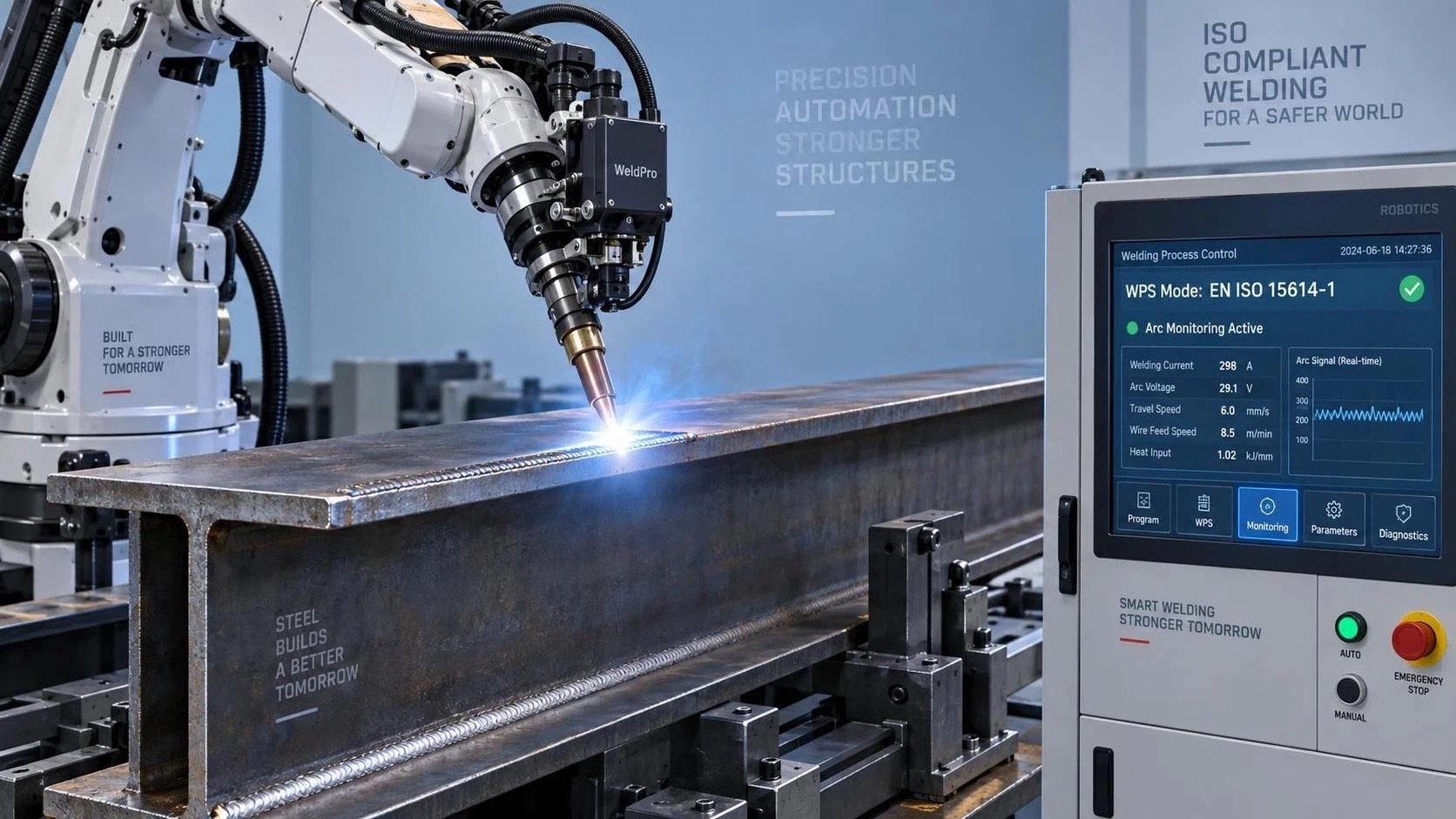
Out of the box? Not quite — why ISO 3834-2 compliance starts *after* the robot arrives
When you’re responsible for quality control or safety in structural steel fabrication, “ISO 3834-2 compliant” isn’t a label you take on faith. It’s a contractual obligation, a traceable record, and often a gatekeeper for project approval — especially in EU markets, infrastructure tenders, or certified fabrication shops. So when procurement asks whether a welding robot for steel structures meets ISO 3834-2 “out of the box”, the honest answer is: no — not in any meaningful, auditable sense.
A robot arm, even one pre-configured with arc sensors, seam tracking, and CE-marked power units, doesn’t carry welding procedure qualifications (WPQs), welder certifications, or documented process parameters. ISO 3834-2 doesn’t certify equipment — it certifies *the organization’s capability to consistently produce sound welds*, based on validated procedures, trained personnel, calibrated equipment, and controlled environment conditions. The robot is just one link in that chain — powerful, repeatable, but inert without context.
What “out of the box” actually means — and where it stops
At Wuxi Samgins International Trade Co., Ltd., we supply CE-compliant, ISO 9001-certified robotic welding systems designed specifically for structural steel — including H-beam production lines where dimensional stability and joint integrity are non-negotiable. Our systems integrate seamlessly with upstream and downstream processes: CNC plasma cutting, automatic feeding frames, and post-weld straightening. But that integration doesn’t substitute for qualification.
“Out of the box” here means the robot arrives with:
- CE marking confirming basic health & safety and electromagnetic compatibility
- Factory-calibrated motion control and torch positioning repeatability (typically ±0.1–0.3 mm)
- Pre-loaded software modules for common joint types (T-joints, butt welds, fillets) and material thickness ranges
- Documentation aligned with ISO 9001 design and manufacturing controls
None of those items satisfy ISO 3834-2 Clause 5.2 (Welding Procedure Specification), Clause 5.3 (Welder Qualification), or Clause 5.4 (Equipment Calibration Records). Those must be generated *on-site*, using your base materials, consumables, joint geometry, and production environment — not in our Wuxi workshop.
The real bottleneck: WPS validation isn’t optional — it’s procedural
For structural steel, ISO 3834-2 requires a written Welding Procedure Specification (WPS) supported by a Procedure Qualification Record (PQR). That means actual test welds — tensile, bend, macro-etch — performed under the exact parameters you’ll use in production: travel speed, voltage, wire feed rate, shielding gas mix, interpass temperature, even ambient humidity if specified.
A robot may hold parameters stable, but stability alone doesn’t guarantee metallurgical soundness. Q345 steel behaves differently at 12 mm vs. 60 mm thickness. Heat input must be controlled to avoid HAZ softening or lamellar tearing — especially in rolled sections where sulfur segregation can be an issue. That’s why qualification isn’t a checkbox exercise; it’s a technical dialogue between your welding engineer, your NDT provider, and your production schedule.
This is where integrated production lines matter. For example, our YTJ-60B and YTJ-80B H beam straightening machine supports continuous flange correction at up to 6.8 m/min — but only after welding has been qualified *and* the beam geometry stabilized. If weld-induced distortion isn’t managed before straightening, correction forces can exceed yield limits or induce residual stress. That’s not a robot limitation — it’s a system-level coordination requirement.
Where hardware *does* accelerate qualification — and where it doesn’t
Some features genuinely reduce qualification time and risk:
- Real-time arc monitoring: Detects voltage/current deviations beyond ±5% — flagging parameter drift before it compromises a PQR coupon.
- Seam tracking with offline teach mode: Lets you simulate weld paths on CAD models first, reducing trial-and-error on test plates.
- Integrated calibration logs: Automatically timestamps sensor calibrations — satisfying ISO 3834-2 Clause 5.4.2 without manual entry.
But none of these eliminate the need for physical test coupons, third-party NDT, or documented review by a Level 3 welding inspector. And crucially — they don’t replace operator competence. A robot won’t stop welding if the wrong shielding gas cylinder is connected. It won’t detect surface contamination missed during pre-weld cleaning. That’s why ISO 3834-2 insists on trained, certified personnel — not just programmed machines.
No shortcuts — but smarter starting points
If you’re evaluating a welding robot for steel structures, ask for evidence — not claims:
- Does the supplier provide a generic WPS template aligned with EN ISO 15614-1 for S355/S460 steels?
- Can their software export raw process data (voltage, current, travel speed) in CSV format for PQR submission?
- Do they offer on-site support during initial qualification — not just installation?
We’ve seen clients save weeks by aligning robot selection with their existing qualification framework — rather than retrofitting procedures to fit a new system. At Wuxi Samgins, our engineering team works with customers early to map robot capabilities against their ISO 3834-2 scope, helping define realistic qualification boundaries before the first test plate is cut.
Because ultimately, compliance isn’t about the robot. It’s about how rigorously you manage the entire process — from material receipt to final inspection. The robot makes execution repeatable. Your systems make it trustworthy.
search
Products Navigation
Send Us A Message