




Fiber or CO2 metal laser cutting machine for reflective metals
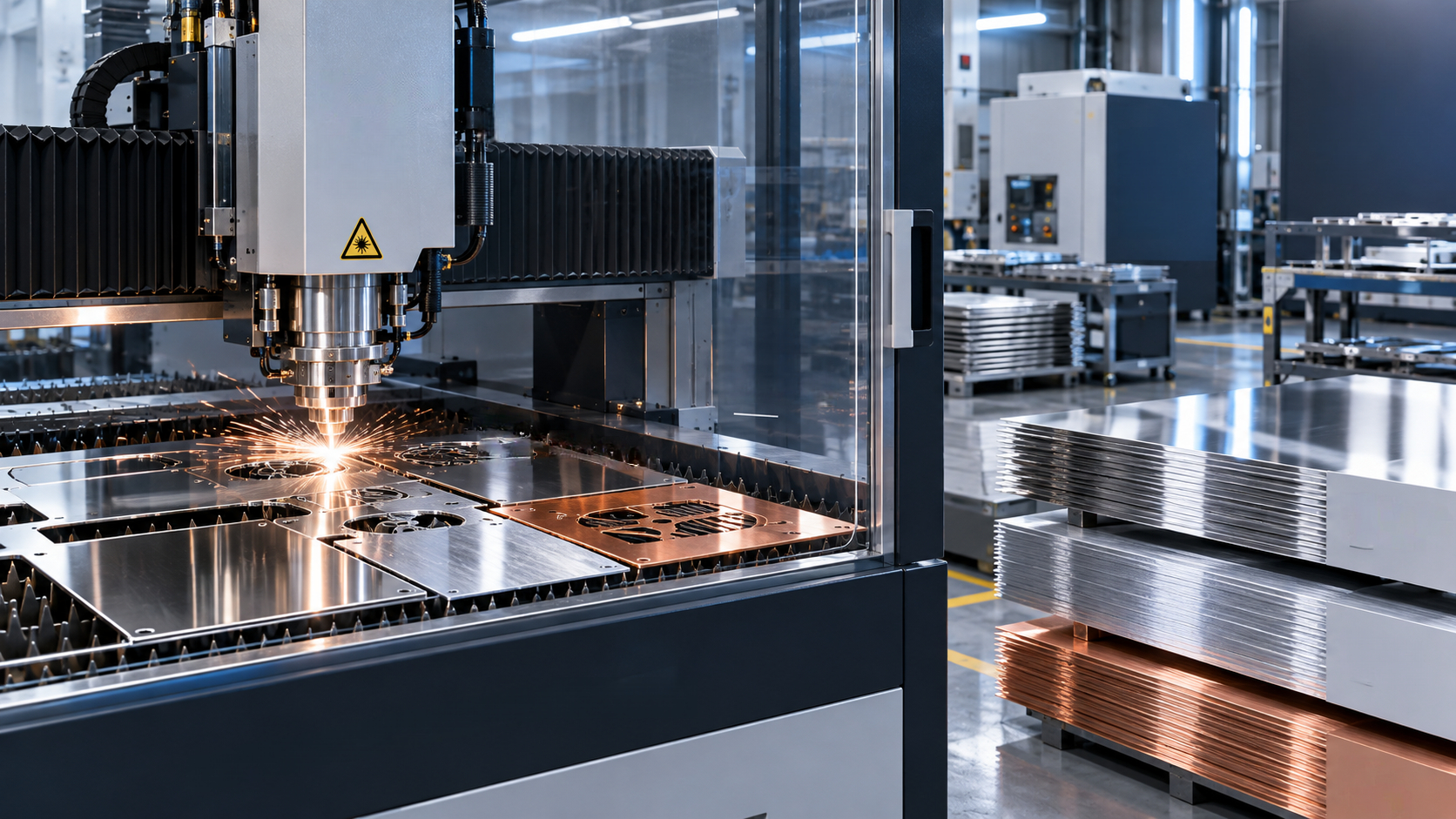
A fiber laser is usually the stronger choice for cutting reflective metals. For aluminum, brass, copper, and polished stainless steel, a modern fiber-based Metal laser cutting machine generally provides better energy absorption, faster processing, lower electrical demand, and a more compact maintenance profile than a CO2 system.
That does not mean CO2 technology has no place in metal fabrication. It can still be practical in facilities that already operate and support CO2 equipment, especially where the work is dominated by thicker non-reflective steel or where an existing machine remains productive. But when reflective metals are a regular part of the production mix, buying a new CO2 laser solely because its initial equipment price appears attractive can create avoidable limitations in speed, operating cost, and process stability.
The decision should be based on the actual material range, thickness distribution, part geometry, required edge condition, assist-gas availability, and the factory's ability to support the machine over its service life. Reflectivity is only the starting point.
Why reflective metals change the laser selection
Aluminum, brass, copper, and some stainless finishes reflect a meaningful part of the laser energy that reaches their surface. A cutting system must deliver enough usable energy into the material to initiate and maintain a stable cut. If too much energy is reflected, piercing becomes less predictable, cutting speed drops, and the process may leave excessive dross or incomplete contours.
Fiber lasers operate at a wavelength that metals absorb more effectively than the wavelength used by CO2 lasers. In practical terms, this gives fiber technology a major advantage when processing thin and medium-gauge reflective sheet. The beam can establish a cut more efficiently, particularly on brass and copper, which are often the most difficult materials in a mixed-metal job shop.
Reflectivity also raises equipment-protection concerns. Reflected light is not simply a cutting-quality issue. It can place stress on optical components if the machine design, cutting head, sensors, and back-reflection protection are not suitable for the material being processed. A buyer should therefore evaluate the complete system, rather than assuming that a high-power source alone makes a machine appropriate for reflective metals.
Fiber versus CO2: the differences that matter on the shop floor
This comparison should not be reduced to “fiber is newer, so fiber is better.” The relevant question is whether the machine will keep producing acceptable parts at the required rate with manageable downtime. For a business cutting a broad range of thin stainless, aluminum enclosures, brass components, and copper busbar parts, fiber normally aligns more closely with that requirement.
CO2 technology becomes more defensible when the work is heavily concentrated in thickness ranges where the plant already has proven programs, trained operators, available spare parts, and a known cost structure. Replacing a functioning CO2 system can be unnecessary if reflective metals are rare and production demand is stable. A new buyer without that installed base should assess carefully whether those operating advantages exist in reality or are only assumed.
Material-by-material selection guidance
Aluminum
Fiber is the normal first choice for aluminum sheet. It handles common fabrication grades effectively and is particularly useful where parts require frequent piercing, narrow features, or short production cycles. Aluminum cutting quality is influenced by alloy, thickness, surface condition, nesting, and assist gas, so a machine demonstration should use the grades and thicknesses that will actually be purchased.
A common mistake is judging aluminum performance from one clean, flat sample. Production material may have protective film, surface contamination, variable flatness, or residual stress. These conditions affect piercing and edge consistency. Ask for test parts with representative holes, slots, sharp corners, and long straight cuts, not only an easy external profile.
Brass and copper
Brass and copper make the case for fiber even clearer. Both materials are highly reflective and thermally conductive, meaning heat can move away from the cutting zone quickly. A capable fiber laser, appropriate cutting head, stable gas delivery, and suitable parameters are needed to produce consistent results.
Do not purchase based only on a supplier statement that the machine “cuts copper.” The useful question is whether it can cut your copper thicknesses, your part geometry, and your expected batch sizes with repeatable piercing and acceptable edge condition. Small holes, dense perforation patterns, and closely nested components create a more demanding heat-management situation than simple large profiles.
Stainless steel
Stainless steel is less problematic than copper or brass, but polished or mirror-finished surfaces still deserve attention. Fiber lasers are widely suited to stainless processing and can produce clean edges when the material, nozzle condition, focal position, and gas settings are properly matched. Nitrogen is often selected where an oxide-free edge is important for downstream bending, welding, cosmetic finishing, or corrosion-sensitive use.
Where a darkened or oxidized edge is acceptable, oxygen-assisted cutting may be considered for certain applications. The choice is not only about speed. It changes the edge condition and may affect later fabrication steps.
Do not select laser power before defining the cutting mix
Laser power is important, but it is not a complete purchasing specification. A higher-rated source may extend capacity or improve cutting performance in some thickness ranges, yet it does not compensate for poor material handling, insufficient gas supply, unstable sheet quality, weak fume extraction, or an unsuitable cutting head.
Build the requirement around the parts that consume most of the machine time. List each material, its grade or condition, thickness, annual or monthly volume, maximum sheet size, typical hole size, tolerance expectations, and required edge quality. Then identify which parts are urgent, frequent, or difficult. This is more informative than selecting a machine from a brochure’s maximum cutting-thickness claim.
For example, a facility producing mostly thin aluminum panels may prioritize acceleration, nesting efficiency, automatic loading, and rapid setup. A manufacturer cutting thicker stainless brackets may place more weight on edge squareness, piercing reliability, and gas consumption. Copper components may require particular attention to back-reflection safeguards and repeatable small-feature cutting. These are different buying cases even if all three operations use a metal laser cutter.
Evaluate the complete cutting system, not only the laser source
A reliable fiber laser installation depends on several connected systems. Weakness in one area can erase the advantage of the laser source.
- Cutting head and protection: Confirm that the head is designed for reflective materials and includes suitable protection against reflected energy. Ask how protective optics are monitored and replaced.
- Assist-gas supply: Nitrogen purity, pressure stability, pipe sizing, and available flow can affect edge quality and cutting consistency. A machine demonstration using a different gas arrangement may not reflect plant conditions.
- Bed and motion system: A rigid frame and stable drive system matter when parts have tight holes, fine corners, or long production runs. Accuracy claims should be considered alongside repeatability, mechanical build, and service access.
- Material handling: Manual loading can be reasonable for low-volume, mixed work. For repeatable sheet production, loading and unloading automation may deliver more practical value than adding laser power that remains idle between sheets.
- Fume extraction: Aluminum, stainless, coated sheet, and mixed materials create different extraction demands. The cutting area, ducting, filter arrangement, and maintenance access must be planned as part of the installation.
- Software and nesting: The controller should make it practical to manage lead-ins, micro-joints, common-line cutting, pierce settings, and material-specific process libraries without forcing operators to rebuild programs for routine work.
Service capability deserves the same level of review. Consumables such as nozzles and protective windows are normal operating items. The decision risk lies in extended downtime when a cutting head, source interface, chiller, control component, or drive system needs support. Before placing an order, clarify training scope, remote diagnostics, spare-parts availability, commissioning responsibility, and the process for handling failures that stop production.
Compare cut quality in the condition the part will be used
A bright edge is not always the right edge, and a fast sample cut is not always the best production setting. Evaluate parts after they pass through the next operation. Are burrs acceptable for assembly? Does the cut edge bend cleanly? Will weld preparation be affected? Does an oxidized edge create a finishing problem? Are hole diameters and corner details stable across a full sheet?
This is especially important for parts that move directly into welding. A poor laser-cut edge can create extra grinding, inconsistent fit-up, or contamination that slows the weld cell. In fabrication lines producing pressure vessels, pipelines, or structural assemblies, the cutting decision should be reviewed alongside the welding workflow. Once the required cut parts are established, equipment such as a Welding manipulator may be relevant for handling longitudinal, circumferential, or internal and external seam work downstream. It is not a substitute for selecting the correct laser, but it can be part of a coordinated fabrication plan where cut quality, fit-up, and welding access all affect throughput.
Common buying errors with reflective-metal cutting
Choosing by maximum thickness alone. Maximum thickness is a capability boundary, not a production target. The more useful measure is how reliably the machine processes the thicknesses that make up daily work.
Ignoring piercing performance. A machine may cut a long contour well but struggle with repeated pierces, especially in reflective material. Parts with many holes can expose this problem quickly.
Assuming all fiber machines handle copper equally. Source quality, head design, machine protection, process libraries, and gas control vary. Fiber technology is the right direction; individual system suitability still needs proof.
Under-specifying infrastructure. Inadequate electrical supply, cooling arrangements, compressed air, gas storage, extraction, or floor layout can delay commissioning or reduce machine performance after installation.
Testing only ideal samples. Test the most troublesome recurring parts, including material with the same surface condition, protective film, and thickness tolerance expected in production.
A practical decision sequence
- Separate the planned workload by aluminum, brass, copper, stainless steel, mild steel, and coated material.
- Rank materials by production hours and by the consequences of poor cutting quality.
- Define the edge condition required after cutting, including bending, welding, painting, plating, or visible-surface requirements.
- Request sample cuts using representative files and material, with particular attention to holes, corners, pierces, and dense nesting.
- Review gas consumption, loading method, extraction, maintenance tasks, and service response as operating factors rather than optional extras.
- Choose fiber as the default for a new installation where reflective metals are regular production materials; retain CO2 only where its established strengths genuinely match the workload and support environment.
The most defensible purchase is rarely the machine with the largest headline specification. It is the system that repeatedly cuts the materials and parts that define the business, while fitting the available utilities, downstream processes, operator capability, and maintenance plan. For reflective metals, that evaluation will usually point toward fiber technology, provided the machine is demonstrated on real production conditions rather than selected on broad claims alone.
search
Products Navigation
Send Us A Message