




How to Select a Metal Fabrication Handling Robot Arm for Mixed Production
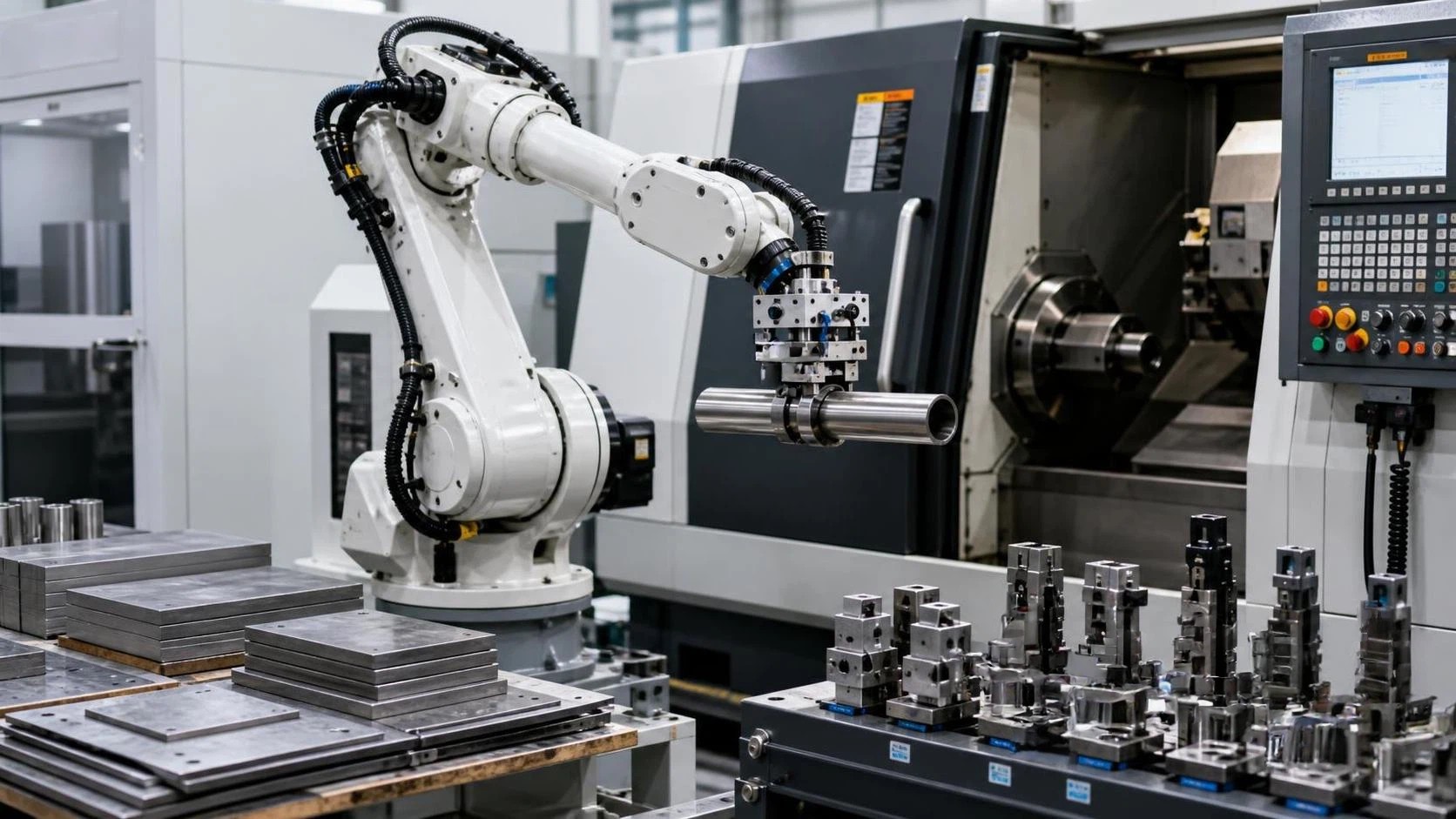
A metal fabrication handling robot arm for mixed production should be selected around the workpiece family and the changeover pattern, not around maximum payload alone. A robot that handles one heavy blank reliably may still be a poor fit when the next job uses thin sheet, a long tube, an oily machined part, or a small batch that changes twice per shift.
For fabrication environments with variable part sizes and frequent order changes, the most practical choice is usually a flexible cell: a robot with adequate payload reserve, a reach that covers every pickup and drop-off point without operating at its limit, and tooling that can be changed or adjusted quickly. The purchase decision should also include the gripper, fixtures, safety system, machine interface, programming approach, and support requirements. These items often determine whether automation improves throughput or simply relocates the bottleneck.
Start with the parts, not the robot catalogue
Mixed production creates a wider range of handling conditions than a dedicated high-volume line. Before requesting quotations, group the parts that may pass through the cell. The useful question is not “How many part numbers do we make?” but “How many different handling methods do those parts require?”
For each representative part, record its finished weight, raw-material weight, largest dimensions, center of gravity, surface condition, temperature at pickup, and allowable contact areas. A flat steel plate may be lifted with vacuum cups or magnets. A perforated or warped sheet may need mechanical clamping. Tubes and fabricated frames often need jaw grippers with locating features. Parts leaving welding stations may require heat-resistant tooling and protection from spatter. Oily components from CNC machines may need gripper fingers that maintain contact without slipping.
Weight must include everything carried by the robot: the workpiece, end-of-arm tooling, tool changers, sensor brackets, cabling, and any part support. Specifying a robot close to its rated payload can reduce usable speed, increase wear, and limit future tooling options. Payload reserve is particularly valuable in a mixed-production cell because the gripper is rarely as simple as the one used on a dedicated line.
Part geometry also affects reach. A long profile can create a large moment load even when its mass is modest. A robot may be able to lift it but still struggle to rotate it safely or place it accurately inside a machine enclosure. Ask suppliers to assess the full load data, including the center of gravity and inertia, rather than approving a robot from weight and reach figures alone.
Define the handling task at every station
“Machine tending” is too broad to support a reliable purchase. The robot's job must be mapped from the incoming rack to the finished-part location. This should include part presentation, identification, pickup, loading, door operation, clamping confirmation, unloading, inspection handoff, and stacking.
A CNC loading cell, a press brake tending cell, and a welding transfer cell impose different requirements. For CNC equipment, the robot may need to open a door, orient a part around fixtures, confirm chuck or vise status, and manage chips or coolant. At a press brake, part support and controlled orientation can be more difficult than the lift itself, particularly with large thin sheet. In a welding cell, access constraints, spatter exposure, and coordination with positioners are often more important than nominal speed.
It is useful to create a simple station map before comparing suppliers:
- Where does each part enter the cell, and in what orientation?
- Can the robot approach the machine fixture without collision or singularity?
- Which actions require confirmation from sensors or the machine controller?
- Where does the part go when a machine fault, quality rejection, or downstream delay occurs?
- How will operators replenish material and remove finished parts without entering a hazardous area?
These details expose hidden costs early. For example, a machine may have sufficient clearance for manual loading but not for a robot gripper. A low-cost robot installation can become expensive when it needs a new fixture, door modification, pallet system, or extended guarding to make the motion path workable.
Choose reach and layout together
Reach should be evaluated against the real cell drawing, not a top-view sketch. The robot needs access to the pickup point, machine loading point, finished-part position, optional inspection point, and any tool rack. It also needs enough clearance to move around guarding, conveyors, positioners, and open doors.
Placing a larger robot farther away is not always an answer. Extended reach can increase cycle time, reduce stiffness at the working point, and occupy more floor space. A compact robot mounted on a pedestal, overhead structure, track, or machine base may serve the same stations with shorter motions. The best arrangement is often the one that keeps frequent movements short and leaves operators clear access for changeovers and recovery.
For long, flexible, or irregular workpieces, simulate the whole swept path. A robot wrist may clear a machine opening while the far end of the workpiece strikes a guard, fixture, or adjacent machine. This is common when handling welded frames, channels, tubular parts, and long threaded products.
Tooling determines how flexible the cell really is
In mixed production, the end effector deserves the same scrutiny as the robot arm. A sophisticated robot with a weak gripper is still a fragile process. The right tooling should locate the part repeatably, tolerate normal variation, avoid damage to finished surfaces, and release reliably even when surfaces are dusty, oily, or slightly distorted.
Do not assume one universal gripper will cover every item. A modular gripper with exchangeable contact fingers can be more economical than an automatic tool changer when part changes are planned by batch. Conversely, when part types change frequently and unattended operation is required, tool changing may be justified by reduced intervention and more stable scheduling.
Gripper sensing is also important. Part-present, grip-confirmation, and double-sheet detection can prevent a single mishandled blank from causing fixture damage or a long production stoppage. For expensive fabricated or machined components, adding a simple confirmation method often costs less than recovering from an undetected loading error.
Cycle time must include variability and recovery
Supplier demonstrations often show the best-case motion time: pickup, fast transfer, and placement under ideal conditions. That number does not represent the productive cycle in a mixed shop. A realistic estimate includes machine door time, chuck or clamp confirmation, vision or sensing time, robot travel, part orientation, tool changes, rack indexing, and the pauses required for safe material replenishment.
More importantly, assess the recovery path. What happens if a part is slightly out of position in a tray? What happens when the machine does not confirm a clamp? Can an operator clear a fault without re-teaching the entire program? A cell that restarts quickly after routine variation can be more productive than a faster cell that needs specialist intervention after every exception.
For low and medium batch sizes, reduce non-cutting or non-welding time before pursuing maximum robot speed. Better rack presentation, repeatable datum locations, and simpler gripper adjustments often generate more useful capacity than selecting a faster arm.
Integration is a cost item, not an accessory
The robot, machine tool, safety equipment, electrical cabinet, and material-handling devices must operate as one system. This requires a defined interface with the welding machine, CNC machine, cutting system, or forming equipment. Clarify which party is responsible for machine signals, door control, interlocks, alarm handling, program selection, and cycle synchronization.
Integration scope should be explicit in the quotation. A low robot price can conceal substantial costs for fixtures, guarding, installation, commissioning, programming, material racks, electrical work, and acceptance testing. Procurement comparisons are more useful when every offer is normalized into the same scope rather than comparing robot-arm prices alone.
Ask for a clear division between standard equipment and custom engineering. Standardized components can simplify spares and future expansion. Custom fixtures may be necessary for unusual parts, but they should be designed so contact points, jaws, and locating pins can be replaced without rebuilding the whole cell.
Consider the process upstream and downstream
A handling robot works best when the process around it is stable. If raw parts arrive mixed, bent, poorly separated, or without a consistent datum, the robot cell may need extra sensing, orientation equipment, or operator preparation. That may still be worthwhile, but it should be planned as part of the project rather than treated as a later adjustment.
This is especially relevant when automating secondary operations around thread production. A thread rolling machine may run continuously on repeated stock, while the handling requirement changes with bar length, blank presentation, thread protection, and how finished parts are collected. For applications involving high-strength fasteners, anchor bolts, T-bolts, or large-pitch threaded workpieces, the Z28-250 thread rolling machine can be assessed alongside the loading and unloading method rather than as a separate purchase. Its manual, semi-automatic, and automatic operating modes allow the automation level to be matched to production volume and part consistency.
The handling system should also protect the value created by the process. Freshly rolled threads, machined surfaces, and finished weldments can be damaged by hard metal-to-metal contact or unstable stacking. Soft contact materials, controlled placement, separated trays, and part-specific nest design may add cost at the beginning, but they can avoid rework and inspection problems later.
Safety and usability affect operating cost
Guarding, interlocked access doors, safety scanners, and collaborative operating modes are choices that depend on the required interaction between people and the cell. A collaborative robot does not automatically eliminate the need for risk assessment, tooling controls, or protected zones. Sharp sheet edges, hot parts, high-inertia loads, and pinch points can require conventional guarding even when the arm itself has force-limiting features.
For mixed production, operator usability matters as much as basic safety. The people changing jaws, loading racks, recovering faults, and selecting recipes should be able to do so through a clear, controlled process. A cell that depends on one programmer for ordinary product changes can create a hidden labor and downtime cost.
Request demonstrations of changeover and fault recovery, not only normal production. The supplier should show how a new part recipe is selected, how gripper adjustments are verified, and how a stopped cycle is returned to a safe state. These are daily operating tasks, not exceptional events.
Compare total ownership cost over the intended production mix
The purchase decision should consider more than the installed price. A useful comparison includes capital equipment, integration engineering, fixtures and tooling, floor preparation, training, planned maintenance, spare parts, software support, and expected changeover labor. It should also reflect the cost of parts that cannot run automatically and still require manual handling.
A highly customized cell may have excellent cycle time for one product family but expensive expansion costs when parts change. A more modular system may cost more initially while keeping later fixture work, programming, and downtime under control. The correct choice depends on whether the current production mix is stable enough to justify dedicated automation.
Before placing an order, build an acceptance list around the parts that matter most: the largest, smallest, heaviest, most flexible, most difficult to grip, and most frequently changed. Include expected loading positions, target cycle conditions, changeover method, machine communications, safety functions, and repeatability of part placement. This turns a broad promise of automation into a purchase specification that can be tested.
The best metal fabrication handling robot arm is not necessarily the one with the highest payload or fastest published speed. It is the one that handles the real mix of parts safely, integrates cleanly with the production equipment, recovers from normal variation, and remains practical to maintain as product schedules change.
search
Products Navigation
Send Us A Message