




What Makes a Heavy Duty Tube Bending Machine Suitable for Thick-Wall Tubes?
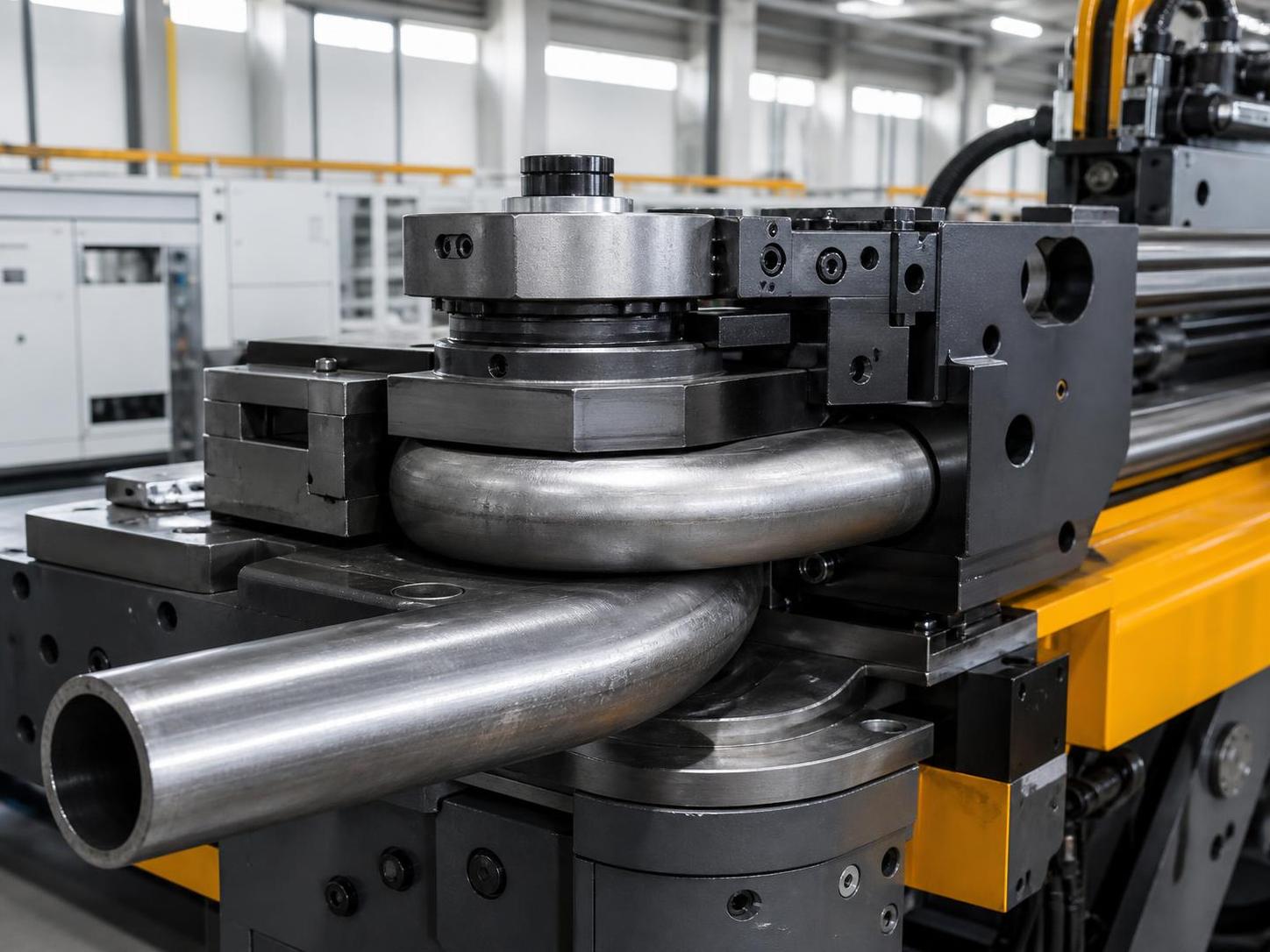
Machine stiffness shows up in the bend long before rated tonnage does
A heavy duty tube bending machine is suitable for thick-wall tubes when the frame, spindle support, bending arm, and clamping structure stay stable under sustained load instead of only meeting a nominal force figure on paper. Thick-wall material resists deformation more strongly than thin-wall tube, so the machine is pushed harder in the straight section before the bend, at the tangent points, and during springback compensation. If the main body twists, the centerline radius can drift, the ovality increases, and the bend angle becomes inconsistent from part to part even when the control program does not change.
In practical evaluation, frame construction matters because heavy-wall bending generates continuous reaction force rather than a brief peak. Welded structures that have been stress-relieved are generally more stable than light fabricated frames with limited reinforcement. The same logic appears in other heavy metalworking equipment: a rigid base and controlled vibration help preserve accuracy over time. That is one reason some fabrication lines pair tube work with edge preparation systems built around stress-relieved structures, such as Heavy Edge Milling Machine, where deformation control is treated as a structural issue rather than a cosmetic one.
Wall thickness changes the bending problem
Thick-wall tubes do not fail in the same way as thin-wall tubes. Thin sections tend to wrinkle or flatten early if support is poor. Thick walls can still ovalize, but they also create a different set of demands: higher torque on the bend arm, more stress on the clamp die, greater risk of surface marking from excessive clamping pressure, and stronger springback after release. Material flow is harder to manage because the outer wall stretches under higher force while the inner wall compresses more aggressively.
This is why a heavy duty tube bending machine should not be judged by outside diameter capacity alone. A machine advertised for a large tube size may still be unsuitable if the stated capacity assumes mild steel with a moderate wall. Once the job changes to heavy carbon steel pipe, duplex stainless, or alloy tubing with tighter bend requirements, the usable range may shrink sharply. The relevant question is whether the machine can produce the required bend radius, angle repeatability, and surface condition at the specified wall thickness without relying on a very slow cycle and repeated manual correction.
Drive system selection affects control at the point of deformation
For thick-wall applications, the drive system has to deliver force smoothly across the whole bend stroke. Hydraulic machines remain common because they can generate high bending force and tolerate demanding sections. Servo-electric or hybrid systems may also be suitable, but only if torque is sufficient at low speed and the machine has enough structural reserve. A machine that reaches the target angle only by slowing dramatically near the end of the stroke may still produce acceptable sample parts, yet lose consistency in production when tool heating, lubrication changes, or batch-to-batch material variation begin to accumulate.
Stable low-speed control matters more than headline speed. Heavy-wall bending often benefits from slower, more controlled movement, especially at bend initiation and during pressure die assistance. Abrupt acceleration can mark the tube or shift the workpiece in the clamp area. If the machine allows programmable speed segmentation through the bend, it becomes easier to handle the early loading phase, the main forming zone, and the final overbend for springback separately.
Tooling compatibility is where many wrong selections become visible
A heavy duty tube bending machine may have enough force, but still perform poorly if the tooling system is too limited for thick-wall conditions. The bend die groove must match the actual tube outside diameter and expected deformation behavior. The clamp die needs enough contact length to prevent slippage without crushing the surface. The pressure die has to support the material through the bend rather than simply pressing against it. For tighter radii or more difficult alloys, mandrel bending may be necessary even with thick walls, particularly when the specification restricts flattening or requires a clean internal profile.
Tool change design also matters. If the machine uses nonstandard die interfaces or difficult alignment procedures, setup time rises and repeatability depends too much on operator compensation. Machines that accept standardized or easily replaceable tooling tend to be easier to maintain across changing jobs. In higher-mix workshops, this can be more important than the maximum theoretical bend force.
It is worth reviewing whether the machine supports:
- multiple bend die radii for the same tube diameter, because thick-wall work is often specified with both structural and flow-related radius constraints;
- pressure die assist adjustment that can be tuned by material family instead of left at a fixed setting;
- mandrel and wiper integration where surface finish or cross-section retention is tightly controlled;
- longer clamping lengths for heavy sections that would otherwise slip during the first degrees of rotation.
Springback control has to be designed into both mechanics and software
Thick-wall tubes can produce less visible collapse than thinner sections, but springback is often stronger and less forgiving when the material has high yield strength. If the control system cannot apply precise overbend values and store compensation by material, diameter, wall, and radius, repeated trial bending becomes routine. That is a production problem, not merely a setup inconvenience, because every compensation cycle consumes tube, machine time, and inspection effort.
A capable machine should allow fine angular correction and reliable position feedback at the rotary axis. Mechanical backlash in the drive train undermines this quickly. When the machine reverses slightly or settles unpredictably near the programmed endpoint, two bends with the same nominal angle can come out differently. Thick-wall parts often reveal these small errors during assembly because their stiffness makes post-bend correction harder.
Software should also support sequence planning for multi-bend parts. Heavy sections are less tolerant of poor collision strategy. A tube that has already taken one or two large bends becomes difficult to reorient in a confined machine envelope. If the controller lacks realistic interference management, the machine may be technically capable of single bends but inefficient or impossible for the actual part geometry.
Centerline radius limits should be treated carefully
One common misjudgment is assuming that a large machine can automatically produce tight radii in thick-wall tube. Radius capability depends on die geometry, tube material, support method, and the machine’s ability to keep the section controlled around the tangent points. A generous diameter capacity does not guarantee a small CLR ratio. In fact, very heavy-wall tubes may be easier at broader radii and much harder when the drawing calls for a compact bend envelope.
When reviewing specifications, the useful detail is the relationship between outside diameter, wall thickness, and minimum achievable radius under a stated process method. If the machine supplier provides only an overall maximum diameter and says the rest depends on material, that is not enough for a technical decision. Material dependency is real, but the machine should still have a defined working range with explicit assumptions.
Material grade and weld seam orientation can change the result
Carbon steel, stainless steel, aluminum alloy, and higher-strength tubing do not respond identically under the same tooling set. Stainless grades may demand more attention to lubrication and surface marking. Aluminum may bend with lower force, yet surface damage or local instability can become the bigger issue. If the tube is welded, seam quality and seam orientation may affect bend appearance and dimensional stability. For critical parts, the process may need a fixed seam position relative to the bend plane.
This becomes especially relevant when tubes arrive from more than one mill source. Even if the nominal size is unchanged, actual wall tolerance, hardness variation, and seam condition can shift the required clamp pressure and overbend value. A suitable heavy duty tube bending machine should therefore have enough adjustment range in both mechanical support and program compensation to absorb normal material variation without becoming unstable.
Length, loading method, and floor conditions are not secondary details
Heavy-wall tubes are often long and difficult to handle. Once diameter and wall increase, the loading problem changes from simple positioning to controlled support. Inadequate infeed support can introduce drag, twisting, or sag before bending even begins. That affects angle accuracy and may score the surface. Machines intended for demanding tube work usually need coordinated supports, clear loading space, and enough open area around the bending envelope to rotate long parts safely.
Foundation and floor rigidity also deserve attention. A machine with strong bending force but poor installation support may transmit vibration into the cycle, lose alignment, or develop uneven wear in guide components. This is one of the quieter reasons why sample acceptance and production stability do not always match.
Accuracy should be discussed in terms of part outcome, not isolated numbers
Quoted positioning accuracy is useful, but it does not fully describe suitability for thick-wall tubes. The more meaningful evaluation combines bend angle repeatability, centerline radius consistency, end rotation control, wall thinning behavior, and ovality after forming. A machine may have precise axis feedback and still struggle if clamp stability or die support is weak. Likewise, a machine with modest-looking control specifications can perform well if the mechanical system is rigid and the tooling package is appropriate.
Inspection plans should therefore match the actual risk points of the part. For some assemblies, angle error is the main issue. In others, end location after several bends matters more than the angle of any single bend. Pressure-bearing applications may place more weight on wall integrity and internal smoothness than on visual appearance alone.
Cycle efficiency depends on how the machine handles heavy workpieces between bends
Throughput in thick-wall bending is rarely limited by pure bend speed. It is often limited by handling, repositioning, and correction. Machines that include practical support features can reduce non-cutting time in the same way robust plate-processing systems use guided movement, stable support, and adjustable feed to maintain consistency on long workpieces. In fabrication environments where bent tubes connect to beveled plates or welded assemblies, equipment such as a Heavy Edge Milling Machine may appear in the same production chain because both operations depend on rigidity, controllable feed, and repeatable geometry rather than operator force.
This does not mean the tube bender and plate beveling machine are interchangeable in any technical sense. The connection is that both reveal whether a workshop is set up for heavy sections as a system. If upstream and downstream processes can hold geometry on carbon steel, stainless steel, or aluminum workpieces with variable thickness, the bending cell is less likely to become the only unstable step.
Maintenance access is part of machine suitability
Thick-wall tube bending puts more stress on pins, bushings, slide surfaces, hydraulic seals, lubrication points, and die contact faces. If these areas are difficult to inspect or service, the machine can drift out of condition before the problem is obvious. Easy access to lubrication circuits, clear wear adjustment methods, and straightforward die alignment procedures are practical indicators of long-term suitability.
Guide elements and moving supports should be examined for wear resistance and replacement simplicity. Heat-treated or detachable guide components are often preferable where repeated heavy loading is expected, because maintenance can be targeted without disturbing the whole structure. That principle is familiar across metalworking machinery and becomes especially relevant when uptime matters as much as first-pass accuracy.
Signs that a machine is underspecified
Several warning signs tend to appear early. The clamp pressure must be raised excessively just to prevent slippage. The bend angle drifts after a short run even though the program does not change. Surface marking appears before the target radius is achieved. The machine produces acceptable bends only at very conservative radii, or only when the operator adds manual support during loading. Another sign is when the controller can store programs but lacks enough process variables to distinguish between similar tubes made from different grades.
Underspecification can also hide behind a successful trial part. A single sample bend in a favorable material heat does not prove production suitability. Thick-wall work should be judged by repeatability across a sequence, not by one bend that required extra setup time and close manual supervision.
A suitable heavy duty tube bending machine for thick-wall tubes holds its geometry under load, applies force in a controlled way, supports the tube properly through the bend, and allows compensation for real material behavior rather than idealized catalog conditions. When those elements are present together, the machine is much more likely to produce stable bends without turning every new part into a troubleshooting exercise.
search
Products Navigation
Send Us A Message