




Which rolling machine suits conical shell fabrication
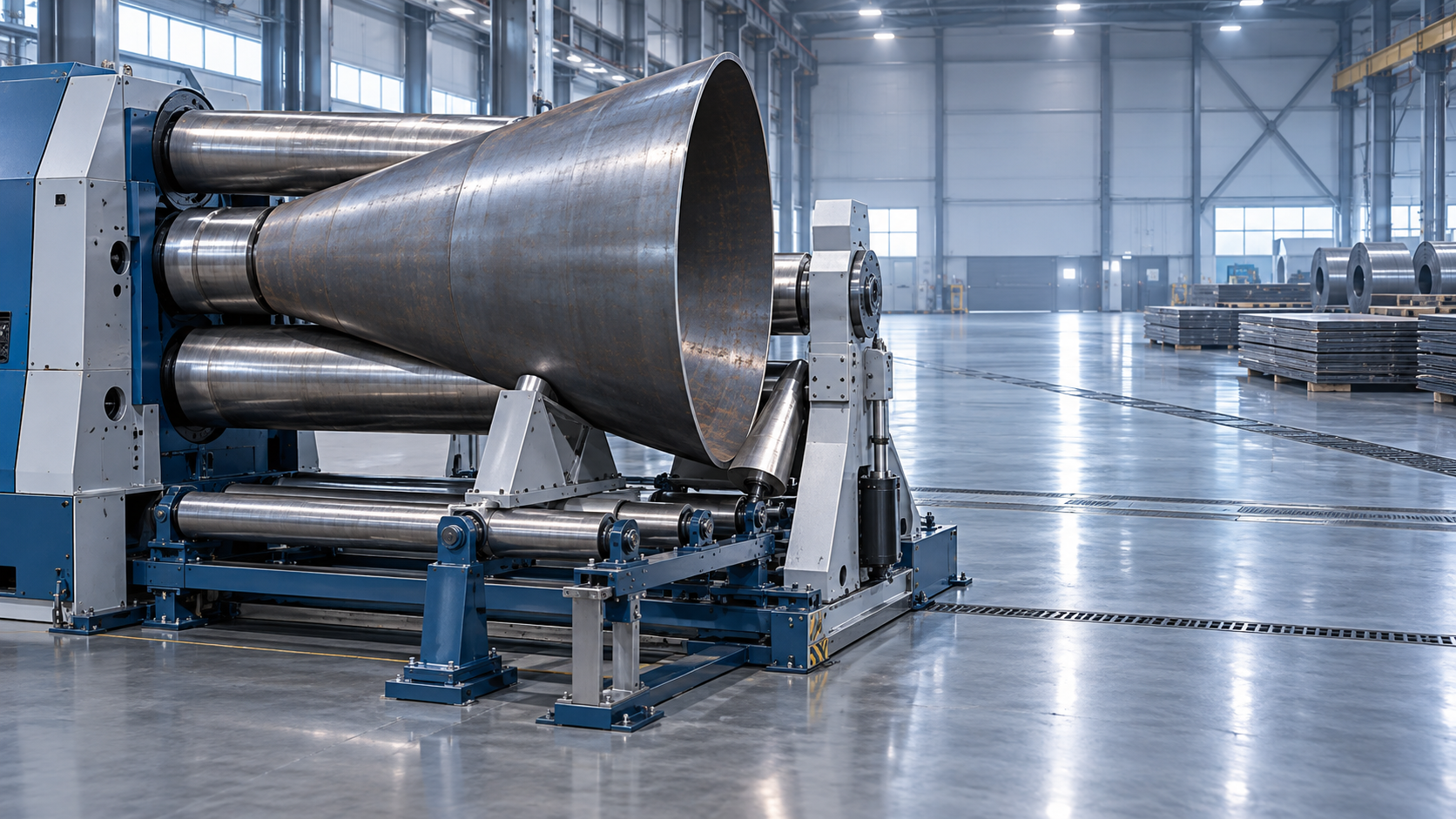
A conical shell is not simply a cylinder with one end reduced. Its rolling process has a continuously changing developed radius, uneven material travel across the plate width, and a higher tendency toward skewing, edge mismatch, and loss of roundness. For that reason, the most suitable rolling machine for conical shell fabrication is usually a three-roll plate rolling machine with independently adjustable side rolls—most often a CNC or NC four-roll machine for repeat work, tighter tolerances, or heavier plates.
A conventional symmetric three-roll machine can form cones, but it is rarely the best choice when delivery dates, weld-fit quality, and material recovery matter. A project should select the machine from the developed cone geometry and production constraints rather than from nominal plate thickness alone. Cone angle, large-end and small-end diameters, plate width, yield strength, seam configuration, and the permitted straight edge all affect whether the selected equipment can produce a shell that closes correctly at the longitudinal seam.
Why cone rolling places different demands on the machine
In cylindrical rolling, both sides of the plate travel through the rolls at nearly the same circumferential speed. In conical rolling, the large-diameter side must travel farther than the small-diameter side during each pass. The plate therefore needs controlled differential movement. If the machine cannot create or sustain that differential, the workpiece tends to wander sideways, producing a cone with an incorrect included angle, a twisted seam, or an uneven overlap at closure.
The issue becomes more pronounced as the cone becomes steeper. A shallow transition cone may be rolled with limited roll offset and careful guiding. A steep cone, a short reducer, or a truncated cone with a relatively small minor diameter demands more decisive roll positioning and better operator control. Plate thickness adds another layer: thicker material resists the localized deformation needed near the small end, while high-strength steels impose greater rolling force and more springback.
For fabrication planning, the practical question is not only whether the machine can bend the plate. It is whether it can repeatedly produce the specified geometry with enough margin for trimming, weld preparation, non-destructive examination, and final dimensional inspection.
The machine configurations that matter
Four-roll plate rolling machines: the strongest general choice
A four-roll plate rolling machine has a top roll, a bottom pinch roll, and two independently moving side rolls. The bottom roll holds the plate securely while the side rolls create the required bend. This arrangement provides several advantages for conical shells:
- The plate can be clamped before bending, reducing the risk of slipping during cone rolling.
- Independent side-roll adjustment makes it easier to establish the asymmetric roll positions required by the cone geometry.
- Pre-bending can be carried out with less unformed flat length at the leading and trailing edges.
- Repeated passes can be programmed or reproduced more consistently than on manually adjusted equipment.
- Plate alignment is easier to control, which is important when the final longitudinal seam must meet strict fit-up requirements.
For pressure-vessel heads, tank reducers, transition pieces, duct cones, hopper sections, and fabricated nozzles, a four-roll machine is generally the most defensible investment when cones are not occasional exceptions. CNC control becomes particularly useful where a project includes several cone sizes, repeated batches, or traceable quality requirements. CNC does not eliminate the need for setup knowledge, but it improves repeatability of roll position, pass sequence, and rework correction.
Three-roll variable-geometry machines: suitable for heavier or more varied work
A variable-geometry three-roll machine uses three independently movable rolls, often arranged in a pyramidal or planetary configuration. Its principal strength is adaptability. The roll positions can be changed to handle a broad diameter range and substantial plate thickness without changing the machine’s fundamental arrangement.
For large-diameter cones, thick carbon steel plate, or mixed fabrication work involving cylinders, cones, and transition shells, this type of rolling machine can be highly capable. It is particularly relevant when the project portfolio requires flexibility rather than the fastest cycle time on one standard part.
The trade-off is setup complexity. The outcome depends heavily on correct roll geometry, plate centering, cone-guide arrangement, and the operator’s ability to interpret the developing shape. A capable machine with poor setup control can still generate a cone that appears acceptable during rolling but fails at seam matching or dimensional inspection.
Initial-pinch and symmetric three-roll machines: limited but not automatically excluded
Initial-pinch three-roll machines, in which two rolls drive or pinch the plate and the third roll provides bending, can form moderate cones when equipped with suitable cone rolling attachments. They may be appropriate for low-volume fabrication, relatively thin plate, shallow cones, and work where a skilled operator can devote time to setup and checking.
Symmetric three-roll machines are less convenient for this task because the plate is not positively clamped in the same way and pre-bending often requires separate handling. They can be economical for basic cylindrical work, but their limitations become visible when a project requires controlled cone angles, short lead times, or low tolerance for scrap. Choosing this configuration solely because its rated thickness matches the plate is a frequent source of avoidable production difficulty.
Assess cone geometry before comparing capacity tables
Machine brochures commonly state maximum rolling thickness and minimum cylinder diameter. These figures are necessary, but they do not answer whether a particular cone is feasible. A cone should be assessed from its flat-pattern dimensions and forming geometry.
The key inputs include the large-end diameter, small-end diameter, axial length, plate thickness, included angle, material specification, and seam location. From these values, the fabricator can determine the sector angle and inner and outer radii of the plate blank. The geometry also indicates how much differential travel is required between the two sides of the plate.
A machine may roll a cylinder at the required thickness but still be unsuitable for a steep cone whose small end approaches the machine’s practical minimum rolling diameter. The minor diameter is often the critical dimension. As the cone becomes steeper, the local bending demand near the small end increases, and the available space between rolls may become a physical constraint.
Another overlooked point is plate width. A cone’s generator length may fit within the stated working length, yet the blank can become difficult to guide if it is narrow relative to its length or if its sector shape creates an unstable entry condition. The rolling machine should therefore be reviewed together with the infeed table, side supports, cone guide, lifting arrangement, and safe work envelope.
Capacity must be derated for material and cone geometry
Nominal rolling capacity is usually stated for a particular material condition, often mild steel with a defined yield strength, and for a specified cylinder diameter. It should not be treated as a universal limit. High-strength carbon steel, stainless steel, duplex grades, clad plate, and abrasion-resistant material may require lower effective capacity because of higher yield strength, springback, surface sensitivity, or layer-bond protection requirements.
The same applies to cone rolling. A machine rated to roll a given plate thickness into a large cylinder may not have adequate force or geometry to form that thickness into the required cone. The project specification should request a supplier calculation or written confirmation based on the actual material grade, thickness, developed blank dimensions, and minimum cone diameter—not a general statement that the equipment “can roll cones.”
Where plate has directional properties, the orientation of the blank relative to rolling direction also deserves attention. The rolling direction can influence springback and may affect the consistency of the final profile. This is especially relevant when several cone segments must be assembled into a larger transition piece.
Attachments are not optional details
A cone rolling attachment or guiding device is often the difference between a controllable process and a trial-and-error operation. The attachment supports and guides the plate so that the narrow end and wide end follow their intended paths while passing through the rolls. Designs vary, but the purpose is the same: to prevent uncontrolled lateral drift and maintain the required cone angle.
For projects with strict dimensional requirements, evaluate the attachment as part of the machine package. Questions worth resolving before purchase include:
- What cone-angle range can be handled without special tooling?
- Can the guide be adjusted for different developed blank shapes?
- Does it support both left-hand and right-hand cone orientations where needed?
- Is its load capacity adequate for the plate weight and planned rolling position?
- Can it be used without obstructing pre-bending, plate loading, or discharge?
- How is the workpiece supported when the formed cone becomes unstable as its diameter changes?
For large or heavy shells, overhead handling and powered support systems are equally important. A plate rolling machine may be mechanically capable, yet the process can remain slow and unsafe if the cone cannot be loaded, rotated, measured, and removed without repeated manual intervention.
Pre-bending and seam allowance affect downstream cost
Every rolling method leaves some degree of flat area near plate ends unless the machine performs effective pre-bending. On a cone, those flat regions can create an uneven seam condition because the two edges do not meet along a simple parallel line. Excessive flat ends may require additional press forming, trimming, or weld-gap correction.
The preferred solution depends on the shell specification. If the finished cone will be trimmed after rolling, a reasonable allowance can be included in the blank. If material cost is high, or the component must retain its full developed length, the machine’s pre-bending capability becomes more important. Project schedules should account for this decision early; otherwise, a nominally inexpensive rolling route may transfer cost into fitting, welding, and corrective work.
Longitudinal seam preparation should also be considered before rolling starts. Some operations bevel the plate edges in flat condition, while others roll first and machine or prepare the seam afterward. Pre-beveling can simplify access and improve consistency, but it requires accurate blank development because later trimming reduces the available land. The selected sequence should match the drawing tolerances and welding procedure rather than be decided only by shop convenience.
Automation improves repeatability, not geometry validation
NC and CNC controls are valuable where cones recur across a contract or where schedule pressure makes manual adjustment expensive. Stored programs can retain roll positions, pass sequences, and pre-bending settings. Digital readouts also make setup changes more visible and easier to document.
However, automation does not compensate for an incorrect flat pattern, unsupported plate edges, or inadequate cone guidance. The first approved part still requires dimensional verification. Large-end diameter, small-end diameter, axial length, cone angle, roundness, seam alignment, and edge condition should be checked at defined stages rather than only after welding. If a rolling error is discovered after longitudinal welding, correction becomes substantially more difficult and may compromise the intended material condition.
When a supplier proposes automated functions, the useful question is whether the control supports the actual fabrication workflow: recipe storage, repeatable side-roll positioning, operator prompts, diagnostic records, and compatibility with the required handling equipment. Broad claims of “automatic cone rolling” are less meaningful than a demonstrated sequence using a representative plate grade and cone geometry.
Specification points that reduce procurement ambiguity
A request for quotation should describe the work rather than merely state a preferred machine model. Include the maximum and minimum plate thicknesses, material grades, plate widths, cone diameter range, cone heights or generator lengths, and the smallest required diameter at the cone end. Identify whether the work includes full cones, truncated cones, eccentric transitions, or multi-piece cone segments. An eccentric transition should not be assumed to behave like a concentric cone; it may require additional forming methods or a different fabrication sequence.
Require the proposed machine configuration to identify roll diameters, roll arrangement, usable working length, independent roll movements, drive system, cone attachment, side supports, control level, and stated capacity for the submitted workpieces. The quotation should also separate standard equipment from optional tooling. This prevents a common mismatch in which a basic roller is priced competitively, while the attachments necessary for conical work are excluded.
Acceptance criteria should focus on formed-part results. Depending on the application, this may include diameter tolerance, cone angle, seam-edge mismatch, out-of-roundness, surface condition, and residual flat length. For regulated pressure equipment, the forming process must also align with the applicable design code, material traceability requirements, welding procedure, and inspection plan. The rolling machine itself does not confer compliance; it is one controlled stage within the complete fabrication process.
A separate process should not be confused with plate rolling
Terminology can create confusion when sourcing machinery internationally. Plate rolling machines form sheet or plate into cylindrical and conical shells. Thread rolling machines form external threads on bar or fastener-type workpieces through cold deformation. They are unrelated processes despite sharing the word “rolling.” For example, a Z28-150 thread rolling machine is intended for precision thread forming on relatively small workpieces, not for producing conical shells from plate.
This distinction matters when project procurement covers multiple fabrication operations. Equipment descriptions, inspection criteria, and supplier capability reviews should use precise process terms: plate rolling for shells, press forming for localized shaping, and thread rolling for threaded components. Clear terminology prevents incorrect quotations and reduces the chance that a technically irrelevant machine is included in a package proposal.
The practical selection decision
For recurring conical shell fabrication, especially where weld fit-up and dimensional consistency affect the critical path, a four-roll CNC or NC plate rolling machine with an engineered cone guide is usually the most balanced choice. It offers better control of plate movement, repeatable asymmetric bending, efficient pre-bending, and simpler handling of repeat parts.
A variable-geometry three-roll machine is a strong alternative where plate thickness, diameter range, or component variety is unusually broad and the fabrication team can support more demanding setup work. Basic three-roll equipment remains viable for shallow, thin, low-volume cones, but it should be selected only after confirming that its roll arrangement, guide system, and handling provisions match the actual blank geometry.
The correct machine is the one that can form the specified cone within tolerance using the real material, with a defined guiding method and a manageable sequence from blank preparation through seam fit-up. That is a more reliable basis for selection than maximum thickness ratings, generic cone capability claims, or the purchase price of the rolling machine alone.
search
Products Navigation
Send Us A Message