




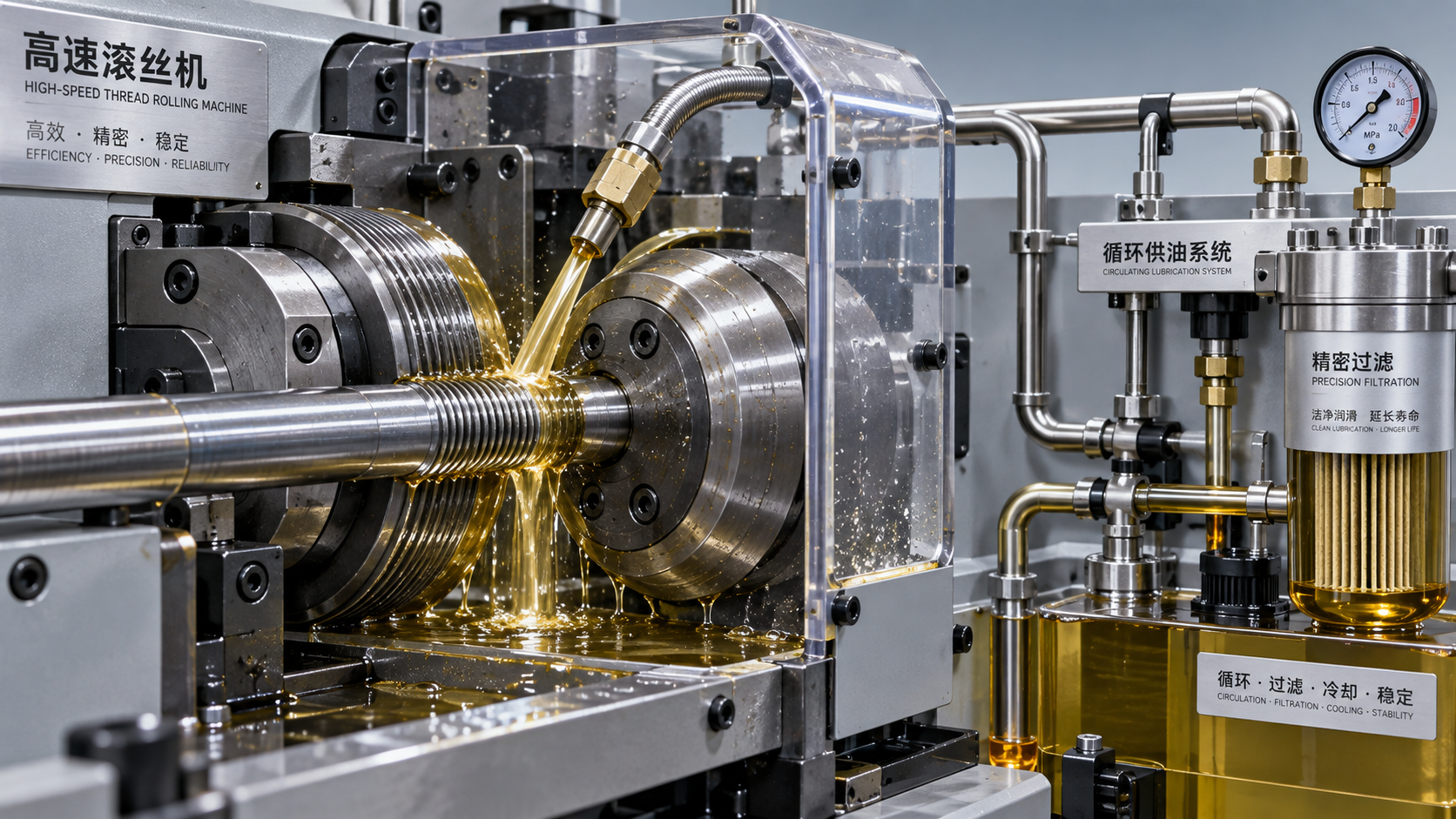
Choosing the right lubricant for a high speed thread rolling machine helps operators reduce die wear, control heat, and maintain consistent thread quality.
Start with the machine manufacturer’s approved lubricant requirements, then match the fluid to your workpiece material, production speed, delivery system, and downstream processing needs.
Viscosity, lubricity, and cooling performance all matter, but their priorities change with operating conditions. The lowest purchase price rarely identifies the most economical option.
This guide explains how to compare lubricant options, recognize inadequate lubrication, and establish practical checks that help prevent avoidable defects, tool damage, and downtime.
What should you check before comparing lubricants?
First, confirm whether your machine requires a straight forming oil or permits a water-miscible fluid. Check the operating manual and consult the equipment supplier.
Some machines use separate fluids for thread forming, hydraulic power, and gearbox lubrication. Keep these circuits distinct, even when their lubricants look visually similar.
Record the workpiece alloy, blank diameter, thread specification, rolling method, production rate, and current lubricant. These details give suppliers a useful starting point.
Also identify the die material, coating, filtration arrangement, pump capability, and seal materials. A suitable forming lubricant must work reliably throughout the entire delivery system.
Ask suppliers for technical data sheets, safety data sheets, recommended operating conditions, and compatibility information. General claims about “excellent lubrication” provide little selection guidance.
When the manual provides limited detail, request written guidance covering fluid type, viscosity, additive restrictions, and maintenance limits before introducing a replacement into production.
How does the workpiece material change your choice?
Thread rolling forms metal through plastic deformation. The lubricant must limit friction and adhesion where the dies contact the blank under substantial pressure.
For carbon and alloy steels, compare forming lubricants with suitable boundary lubrication and extreme-pressure performance. The required protection depends on material condition and deformation severity.
Stainless steels can present greater adhesion and galling challenges. Discuss suitable additive chemistry with the lubricant supplier and confirm compatibility with the actual alloy.
For aluminum, prioritize products formulated for aluminum forming, with suitable anti-welding properties and staining resistance. Validate surface appearance and cleaning performance using representative blanks.
Copper-containing alloys require particular attention to additive compatibility. Certain active sulfur formulations can stain or attack these materials, so obtain explicit supplier confirmation.
For every material, consider the next operation. Residues must be removable before plating, coating, heat treatment, or welding, according to that process’s requirements.
Which matters more: viscosity, lubricity, or cooling?
Viscosity affects how the fluid flows, reaches the contact zone, drains from parts, and passes through filters. It does not describe overall forming performance.
A thicker oil may support film formation, but excessive viscosity can restrict delivery, increase drag, and leave more residue on finished parts and equipment.
A thinner oil may circulate more easily and drain faster, yet still needs appropriate additive chemistry to protect heavily loaded die and workpiece surfaces.
Lubricity reduces friction during forming. Boundary and extreme-pressure additives help protect surfaces when the fluid film alone cannot keep the contacting metals sufficiently separated.
Cooling becomes more significant as sustained production raises fluid and tooling temperatures. Water-miscible fluids generally remove heat more effectively, where the machine permits their use.
Compare viscosity at the same stated reference temperature, and evaluate behavior at actual operating temperature. Avoid selecting a universal viscosity grade without machine-specific evidence.
Should you use straight oil or a water-miscible fluid?
Straight forming oils can provide strong lubrication and corrosion protection when correctly selected. Their suitability depends on the machine, material, load, and operating environment.
Potential disadvantages include oily residue, mist generation, and less effective heat removal than water-based systems. Assess ventilation, housekeeping, and the fluid’s documented handling requirements.
Water-miscible fluids can offer effective cooling and easier cleaning in approved applications. Their forming performance depends on formulation, concentration, water quality, and maintenance.
Do not substitute a general machining coolant simply because it works on a nearby lathe. Thread forming may demand different load-carrying and anti-galling performance.
Water-based systems require concentration control, corrosion monitoring, and attention to microbial contamination. Incorrect dilution can undermine lubrication, fluid stability, and protection of machine surfaces.
Choose between these categories using manufacturer approval and controlled production results. Neither fluid type is automatically the best choice for every high-speed application.
Can the lubricant actually reach the rolling contact?
Even a well-matched lubricant performs poorly when blocked filters, weak flow, or misplaced nozzles prevent it from reaching the dies and blank consistently.
Inspect delivery coverage using the manufacturer’s safe setup procedure. Position nozzles to supply the incoming contact region without interfering with guards or moving components.
Check reservoir level, pump operation, hoses, return passages, and filter condition. Compare flow with documented machine requirements instead of judging only by visible splashing.
Persistent foam can interfere with pumping and fluid delivery. Investigate air leaks, return-flow turbulence, contamination, and fluid suitability before adding a supplier-approved defoamer.
Metal fines and debris can damage surfaces and accelerate die wear. Maintain filtration appropriate to the machine and fluid, while avoiding excessive flow restriction.
Record fluid temperature after a consistent warmup period and during sustained production. Rising temperature can indicate restricted circulation, inadequate cooling, or changing operating conditions.
Which symptoms point to lubrication problems?
Look for changes from a stable production baseline: increasing rolling load, unusual temperature rise, metal pickup on dies, surface tearing, or accelerated tooling wear.
These symptoms justify investigation, but they do not prove the lubricant is responsible. Blank size, hardness, die alignment, and tool condition can produce similar problems.
If threads show tearing or galling, inspect fluid delivery, contamination, and lubricant suitability alongside blank properties. Follow the approved procedure before accessing the tooling.
If thread dimensions drift as production continues, check thermal conditions and machine setup. Measure finished parts using the specified gauging method and inspection frequency.
Rust on parts or machine surfaces can indicate inadequate protection, unsuitable water quality, or incorrect concentration. Investigate storage and handling conditions as well.
When serious defects appear, isolate affected output and follow the plant’s quality procedure. Continuing production can turn a manageable lubrication issue into substantial scrap.
How should you test a replacement lubricant?
Establish a baseline using the current fluid under stable conditions. Record acceptable output, reject rate, die condition, rolling load where available, and operating temperature.
Select a representative job that exposes the problem you want to solve. An easy, short production run may conceal weaknesses during sustained operation.
Keep blank material, tooling condition, machine settings, and inspection methods consistent. Change one major variable at a time so the results remain interpretable.
Before filling, follow the machine and lubricant suppliers’ changeover instructions. Incompatible residues can cause deposits, foaming, or unstable emulsions and undermine an otherwise suitable product.
Evaluate thread dimensions, surface condition, temperature stability, residue removal, and operator handling. Agree acceptance criteria beforehand, including a stopping point if quality deteriorates.
Extend evaluation sufficiently to assess sustained performance before claiming longer die life. Compare total cost per acceptable part, including consumption, cleaning, scrap, and downtime.
What should operators check each shift?
Before startup, check fluid level, leaks, visible contamination, filter indicators, and nozzle security. Confirm that the correct lubricant is available for any required replenishment.
For water-miscible fluids, measure concentration using the supplier’s specified method. Apply the correct refractometer factor, and recognize that contamination can distort the reading.
Use the recommended water quality and mixing procedure. Account for both evaporation and carryout when adjusting concentration; replenishment needs can differ during production.
For straight oils, monitor appearance, contamination, and operating temperature. Where required, arrange laboratory analysis to assess viscosity changes, water contamination, or other condition indicators.
Log unusual odor, persistent foam, rust, skin irritation, and changes in thread quality. Escalate concerns through the plant’s maintenance, quality, or occupational health procedures.
Schedule reservoir cleaning and fluid replacement according to condition and supplier guidance. Isolate hazardous energy before maintenance, and dispose of used fluid appropriately.
How do you prevent problems elsewhere in the workshop?
In mixed manufacturing workshops, lubricant selection also affects cleaning, storage, and subsequent fabrication. Keep fluid containers clearly labeled and use dedicated transfer equipment.
A part that rolls successfully can still fail a later process if residual lubricant remains. Validate cleaning against the actual downstream acceptance criteria.
Wuxi Samgins International Trade Co.,Ltd supplies thread rolling machines and other manufacturing equipment. Discuss lubricant requirements for the specific machine model and intended production application.
Its broader equipment range includes the 7 axis railway type welding robot, combining a six-axis welding robot with a servo-driven rail carriage for workpiece welding.
For parts moving from forming into a welding workflow, confirm surface cleanliness with the welding procedure requirements. Lubricant residues can contribute to welding defects.
Keep forming-fluid decisions tied to the thread rolling operation, while coordinating cleaning with downstream teams. This helps prevent local improvements from creating later quality problems.
Choose the lubricant you can verify and maintain
The right lubricant for a high speed thread rolling machine satisfies equipment requirements, protects the workpiece and dies, and performs consistently under actual production conditions.
Prioritize approved fluid type, material compatibility, reliable delivery, and appropriate lubrication performance. Then evaluate cooling, cleanliness, operator handling, and compatibility with subsequent processes.
Use a controlled trial to confirm quality and operating stability, supported by realistic cost measurements. Avoid accepting performance claims that your production evidence cannot substantiate.
Once the choice is validated, maintain flow, filtration, concentration where applicable, and clear shift records. Consistent fluid management is essential to preserving the expected benefits.