




Tube Bending Machine Selection Guide for Thin-Wall and Thick-Wall Tubes
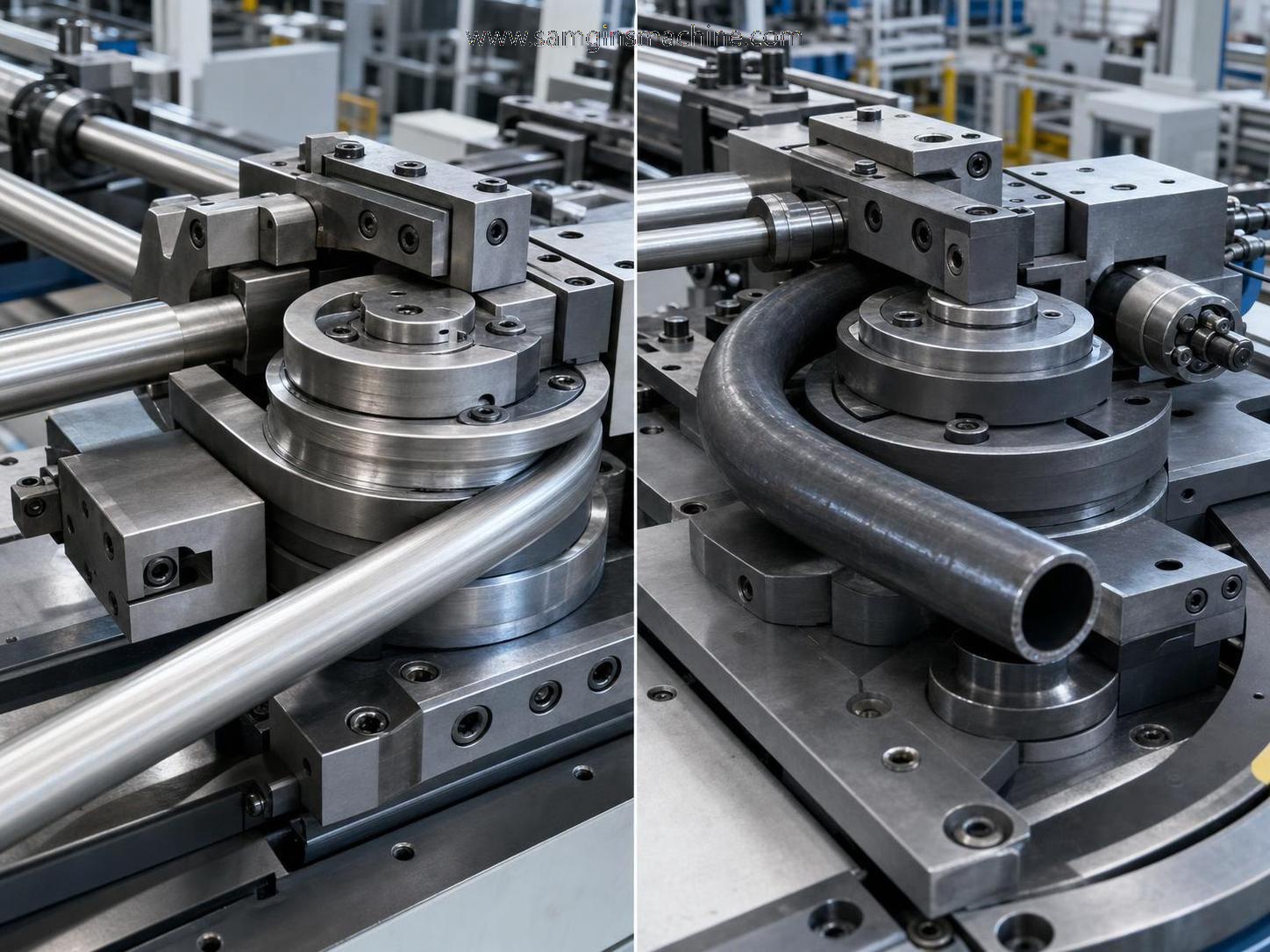
Choosing a Tube bending machine for thin-wall and thick-wall tubes is rarely a simple equipment decision. Bend radius, wall stability, springback, tooling match, and production rhythm all influence whether a line delivers consistent parts or creates hidden scrap and rework.
In metal fabrication, tube bending affects downstream welding, fit-up, sealing, and assembly accuracy. A machine that performs well on heavy structural tube may struggle with light-gauge stainless or aluminum, while a setup optimized for delicate sections may limit output on thicker materials.
That is why the selection process should focus less on headline capacity alone and more on the relationship between material behavior, tooling support, control precision, and the actual production mix.
Why wall thickness changes the machine requirement
Wall thickness directly changes how a tube reacts during bending. Thin-wall tubes are more likely to wrinkle, flatten, or collapse. Thick-wall tubes usually resist collapse better, but they demand more force and often create stronger springback.
A suitable Tube bending machine must therefore control different failure modes. For thin-wall work, support and forming stability matter most. For thick-wall work, drive torque, frame rigidity, and repeatable angle compensation become more important.
This distinction matters in industries such as automotive components, HVAC tubing, furniture, process piping, agricultural equipment, and structural fabrication, where dimensional tolerance often drives final product quality.
Core machine types and where they fit
Not every Tube bending machine uses the same bending principle. The preferred design depends on geometry, wall ratio, material grade, and output target.
For mixed production, rotary draw CNC systems are often the most flexible choice. They can support thin-wall stainless tube, copper, mild steel, and thicker structural sections when the tooling package is properly matched.
What deserves closer attention in thin-wall bending
Thin-wall tubes place the highest demand on support technology. A Tube bending machine intended for this work should be evaluated with the full tooling system, not just the machine body.
- Mandrel compatibility for small radii and reduced flattening
- Wiper die support to reduce wrinkling at the intrados
- Clamp and pressure die stability during feed and rotation
- Servo control precision for angle repeatability
- Surface protection for polished, coated, or soft materials
It is also useful to check the machine’s response to low wall-thickness-to-diameter ratios. Many quoted capacities look acceptable on paper, yet real parts fail when radius tightens or lubrication conditions change.
In practical trials, ovality and wall thinning should be measured, not estimated. That data reveals whether the Tube bending machine can hold process capability over a full batch instead of a few sample bends.
What changes when thick-wall tubes are the priority
Thick-wall tubes usually reduce collapse risk, but they shift the challenge toward force, stiffness, and compensation. Here, the Tube bending machine must maintain control under higher forming loads.
Frame rigidity matters because deflection affects angle accuracy. Drive power matters because underpowered machines may slow down, mark the tube, or fail to maintain consistent bends during long cycles.
Springback is another issue. Thick-wall carbon steel and high-strength alloys often need precise overbend adjustment. A machine with stable CNC compensation and repeatable servo positioning reduces manual correction time.
Tool life should also be reviewed. Higher bending force accelerates wear on dies, clamps, and pressure surfaces, which affects long-run cost more than initial machine price.
Selection criteria that matter more than nominal capacity
A well-chosen Tube bending machine is defined by process fit. Capacity range is only one line in the evaluation.
Material and geometry match
Check outside diameter, wall thickness, centerline radius, bend angle, and straight length requirements together. Material family also changes results. Stainless steel, aluminum, copper, and high-strength steel do not behave alike.
Tooling ecosystem
A strong machine without accessible tooling support creates delays. Confirm die customization, mandrel options, wear parts availability, and changeover time before final approval.
Control and repeatability
For multi-bend parts, software and axis coordination are major value drivers. Repeatable feed, rotate, and bend positioning reduce cumulative deviation across the part.
Integration with the wider line
Bending quality is only part of the workflow. Loading, unloading, part orientation, and transfer to welding or assembly should be considered early, especially in automated fabrication environments.
Looking beyond the bender itself
Tube processing often sits inside a broader fabrication system. Companies with experience across welding, CNC cutting, plate processing, and structural equipment usually assess bending needs more realistically.
Wuxi Samgins International Trade Co.,Ltd has worked in mechanical equipment supply since 2012, covering bending machines, CNC machine tools, welding systems, laser cutting equipment, and H-beam production solutions for multiple export markets.
That broader manufacturing context is useful because bending decisions often influence fixture design, weld accessibility, and handling safety. In heavy fabrication, part turning and positioning can be just as important as the forming step itself.
For example, in structural lines, a positioning solution such as H beam Chain turnover machine supports controlled 360 degree rotation, remote operation, and synchronized handling of long, heavy workpieces.
Although it serves a different process, the lesson is relevant. Machine selection should reflect the full production route, including handling stability, operator safety, and downstream positioning accuracy.
Common evaluation mistakes during comparison
Several mistakes appear repeatedly when comparing a Tube bending machine across suppliers.
- Approving equipment from maximum tube size only
- Ignoring minimum radius and wall ratio limits
- Assuming sample bends represent production stability
- Separating machine review from tooling review
- Underestimating setup skill, maintenance, and spare parts access
- Failing to compare scrap rate, cycle time, and changeover together
A better approach is to request bends using actual tube material, actual radii, and actual tolerance requirements. That makes the comparison far more reliable than catalog data.
A practical framework for the final decision
A useful decision framework starts with the part family, not the machine model. Group parts by diameter, wall thickness, material, bend radius, annual volume, and downstream quality requirement.
Then compare each Tube bending machine against those groups. Score forming stability, repeatability, tooling flexibility, automation readiness, maintenance demand, and operating cost.
Where requirements overlap, the best result usually comes from balancing flexibility with proven process windows, rather than chasing the broadest specification sheet.
The next step is to turn these criteria into a short comparison matrix, validate it with production-style samples, and confirm how the machine will fit the wider manufacturing flow over time.
search
Products Navigation
Send Us A Message