




What production records should a handling robot arm manufacturer provide?
What Production Records Should a Handling Robot Arm Manufacturer Provide?
For quality control and safety teams, production records are not paperwork to request after the purchase order is issued. They are the evidence needed to verify traceability, compliance, and repeatable performance before a handling robot arm enters a live manufacturing area. A reliable handling robot arm manufacturer should be able to show how critical components were inspected, how the machine was assembled and calibrated, what safety functions were tested, and whether the final configuration matches the approved technical specification.
This matters most where a robot is connected to real production equipment rather than operating as a standalone demonstrator. A handling arm loading a CNC machine, transferring laser-cut blanks, moving welded cylinders, or tending a heavy fabrication cell becomes part of a larger risk chain. If the arm, end effector, fixture, guarding, control logic, and peripheral equipment are documented separately but never verified together, a compliant-looking cell may still create operational gaps.
The best documentation package is not necessarily the thickest one. It is the package that lets a buyer answer practical questions: What exactly was built? Which parts can be traced? Who approved key inspections? What parameters were measured? Which safety functions were tested? And what changed between the original quotation and the shipped machine?
Start with configuration control, not a generic brochure
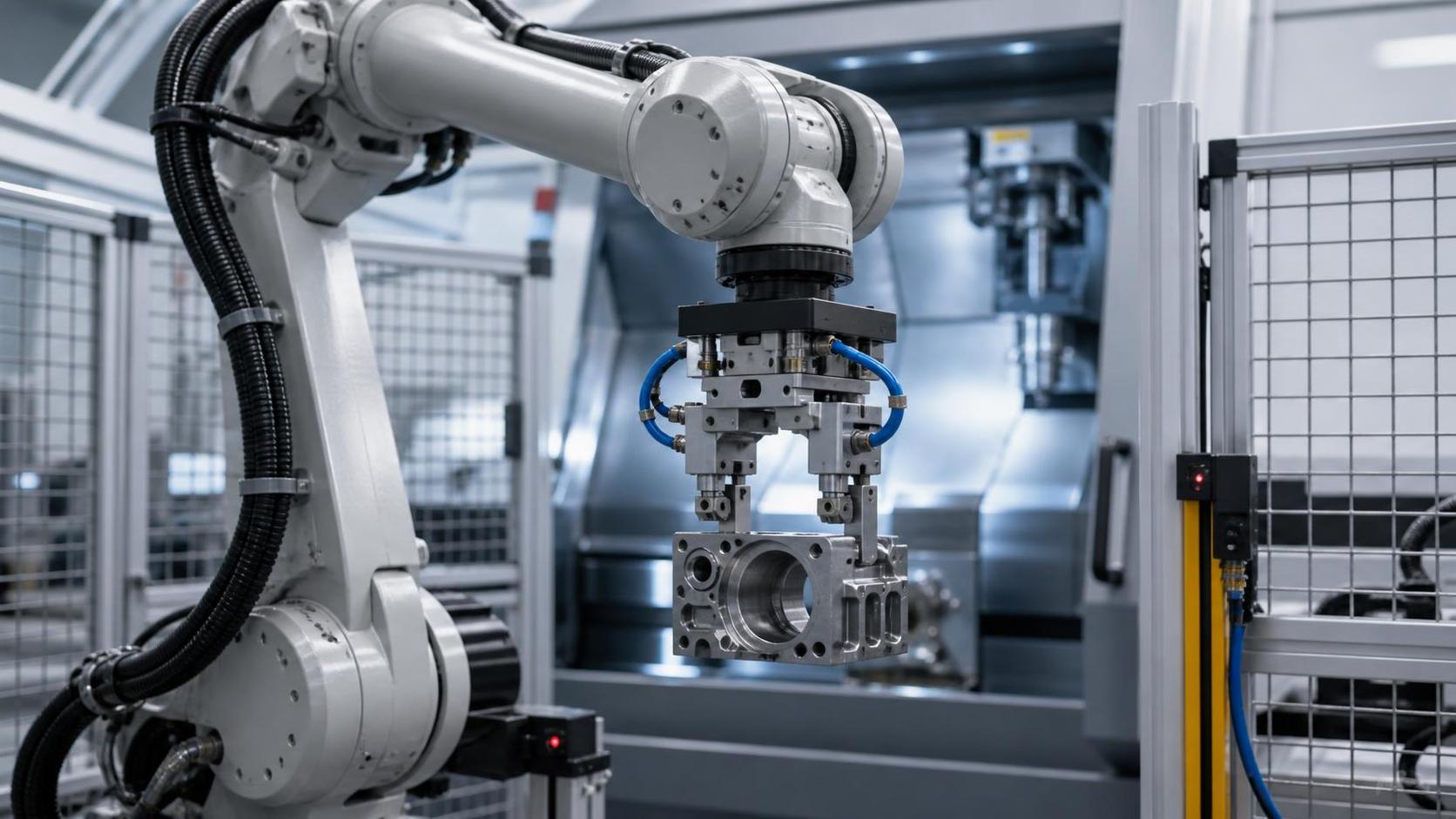
A production record set should begin with an approved equipment configuration. This usually includes the robot model, payload rating, reach, controller version, end-of-arm tooling, cable arrangement, base or track arrangement where applicable, and the intended process interface. For a handling system, the tooling details are particularly important. A vacuum gripper, magnetic lifter, fork tool, clamp, or custom fixture changes both the actual payload and the hazards that must be controlled.
Quality personnel should look for a clear distinction between nominal robot capacity and the installed working load. A robot rated for a stated payload may not be suitable for that same payload once gripper weight, mounting plates, hoses, cable dress packs, offset distance, and dynamic movement are considered. The supplied record should state the approved end-effector mass and, where relevant, the centre-of-gravity assumptions used for the project.
A useful configuration dossier normally contains:
- Approved general arrangement drawing and footprint dimensions;
- Robot, controller, gripper, sensor, and safety-device identification;
- Electrical schematics and pneumatic or hydraulic diagrams where used;
- Bill of materials for safety-relevant and major functional components;
- Software, PLC, HMI, and robot-program revision records;
- A controlled list of deviations, approved substitutions, and late-stage changes.
The last point is often overlooked. A substitute proximity sensor, revised gripper jaw, different servo drive, or altered cable routing may be sensible in production, but it should not disappear into workshop practice. If the delivered equipment differs from the approved design, the manufacturer should identify the change and show that it was reviewed.
Material and component traceability should follow the risk
Not every washer requires the same documentary depth. Good manufacturing control focuses traceability on components whose failure could affect safety, positioning accuracy, load retention, or machine availability. For a robot arm system, this commonly includes structural steel or fabricated bases, critical fasteners, lifting or gripping components, servo motors, reducers, brakes, safety relays or safety controllers, electrical protection devices, and pneumatic components used to hold a load.
Where the supplier fabricates a robot pedestal, tool frame, or welded support structure, material receiving records and fabrication inspection records should be available. Depending on the design and contractual scope, these may include material certificates supplied by the mill, incoming inspection logs, weld procedure references, welder qualification records, visual weld inspection, dimensional checks, and coating inspection. Buyers should not assume that a painted base is automatically a verified base.
For purchased robot bodies and branded control components, traceability is generally established through serial numbers, supplier certificates, delivery records, and incoming inspection. The key is that the serial number on the paperwork matches the machine actually delivered. It sounds basic, but mismatches can become expensive when a fault appears later and the warranty team cannot identify the installed controller or drive version.
Assembly records should prove more than “assembled and checked”
An assembly checklist has value only when it records measurable work or an accountable inspection. A one-line statement saying that the system was assembled according to drawings gives little confidence. Better records identify the main assembly stages and include signatures, dates, torque confirmation where specified, wiring inspection, cable movement checks, lubrication confirmation where relevant, and verification of labels and warning markings.
For handling robots, cable management deserves special attention. Repeated motion can damage poorly routed cables long before a major mechanical problem becomes visible. Production records should indicate that axis travel was checked, cable bend radii were respected, strain relief was fitted, and the routing did not interfere with moving axes, guards, or peripheral equipment. This is especially relevant when a standard robot is adapted with custom grippers, dress packs, or external axes.
The manufacturer should also retain electrical test records. At a minimum, the scope should be agreed for continuity, insulation-related checks where applicable, protective-earth verification, enclosure checks, and confirmation that electrical components match the approved schematic. The exact tests depend on the machine architecture and destination requirements, but the test method and result should be traceable rather than assumed.
Calibration and functional verification need stated acceptance criteria
A robot does not need metrology-laboratory documentation for every movement, but it does need evidence that it was commissioned against a defined functional standard. The relevant records may include mastering or zero-position confirmation, axis-direction checks, programmed speed limits, payload settings, tool-centre-point data, repeatability checks where required by the application, and verification of communication with connected machines.
A recurring problem in automated handling projects is that a robot is tested with an empty gripper, then accepted for production handling without a full-load cycle test. The meaningful test is the one that reflects actual work: intended workpiece geometry, expected gripping condition, planned speed, approach path, release position, and process cycle. If the final part was unavailable during factory testing, the report should say so plainly and define what remains to be validated during site acceptance.
Measurement tools used for critical acceptance checks should themselves be controlled. A manufacturer does not need to provide calibration certificates for every hand tool in the workshop, but instruments used to make acceptance decisions—such as torque tools, load measurement devices, electrical testers, or dimensional equipment—should have identifiable calibration or verification status under the supplier’s quality system.
Safety records must reflect the complete cell
CE marking and ISO9001 are often mentioned together, but they answer different questions. ISO9001 concerns the management system used to control processes. CE-related obligations concern the conformity of the specific equipment placed on the market within the applicable regulatory framework. An ISO9001 certificate does not, by itself, prove that a robot cell is safe or CE-ready.
For equipment intended for markets requiring CE documentation, the manufacturer should be prepared to provide the relevant declaration, technical documentation within the appropriate supply arrangement, instructions, markings, and safety assessment records. The exact document set depends on whether the supplier is delivering a complete machine, partly completed machinery, a robot unit, or an integrated production cell. This distinction should be resolved before contract release, not after shipment.
A useful safety file should include a project-specific risk assessment. It should identify foreseeable hazards rather than merely list generic robot risks. Examples include crushing between the robot and fixture, falling workpieces after loss of vacuum or air pressure, unexpected restart after an interruption, collision with an operator during setup, and access to a welding, cutting, or machining process while the robot is in automatic mode.
The safety validation record should demonstrate actual checks of the selected safeguards: emergency-stop circuits, guard interlocks, safety scanners or light curtains where installed, enabling devices for teaching, mode selection, restart prevention, safe limited-speed functions if part of the design, and controlled stopping behavior. A wiring diagram is not validation. Teams should ask whether the safety function was tested at the machine, what result was expected, and who signed the test.
Interfaces with welding and handling equipment require shared records
The documentation burden increases when the robot is part of a fabrication line. Consider a cell where a handling arm positions cylindrical parts near a rotator for longitudinal or circumferential welding. The robot supplier may document the arm correctly, while the rotator supplier documents its own drive and controls, yet neither party verifies the handshaking signals, safe operating zones, or what happens when one machine faults.
This is why interface control records are worth requesting. They should define start permission, hold signals, fault status, emergency-stop interaction, part-present logic, manual-mode restrictions, and responsibility for the final cell validation. In heavy welding workshops, equipment such as a Lead screw welding rotator may rotate cylindrical workpieces through VFD-controlled speed regulation. If such equipment is linked to automated handling, the records should establish whether the robot may enter the operating envelope while rotation is enabled and how both systems are brought to a safe state.
This is not a theoretical issue. A remote hand control box, forward/reverse rotation command, and adjustable speed setting can be appropriate for manual welding work, but their interaction with automatic equipment must be intentionally designed. Production and acceptance records should capture that decision instead of leaving it to site operators.
Factory acceptance records should be usable at site
Before shipment, a factory acceptance test report should connect the purchase specification with the equipment that was actually tested. It does not need to be theatrical. A concise report with test conditions, machine serial numbers, configuration status, functions checked, exceptions, and customer witness comments is often more useful than a long report full of tick boxes.
The report should identify open points honestly. For example, factory acceptance may verify robot movement, gripper actuation, safety circuits, and dry-cycle logic, while site acceptance may be needed to confirm part variation, upstream machine signals, local guarding, floor anchoring, utility quality, and actual production throughput. Hiding these boundaries makes later disputes more likely.
For export projects, document control also affects installation speed. Wuxi Samgins International Trade Co., Ltd., established in 2012 in Wuxi, supplies welding equipment, CNC machine tools, cutting systems, fabrication machinery, and related equipment to markets including Southeast Asia, Europe, the Americas, and Oceania. In cross-border deliveries, a structured document register is especially helpful because the buyer, installer, local safety reviewer, and maintenance team may all need different parts of the same file. Clear English manuals, serial-number lists, electrical drawings, CE-related documents where applicable, and packing-linked equipment identification reduce avoidable confusion.
A practical release checklist for quality and safety teams
Before approving shipment or site installation, ask the handling robot arm manufacturer for a controlled dossier rather than isolated certificates. At minimum, it should tie together the approved configuration, major component traceability, assembly and electrical inspections, calibration or functional test results, safety validation, factory acceptance findings, manuals, spare-parts information, and a documented list of unresolved items.
Also check ownership of the final risk assessment. If the supplier provides only a robot arm, the integrator or end user may need to complete the assessment for the finished cell. If the supplier delivers the full automated system, the responsibility should be more clearly defined. Neither arrangement is inherently wrong; uncertainty is the real risk.
A competent manufacturer will not treat these questions as an administrative nuisance. They will understand that production records are part of the machine’s quality evidence. When a robot later requires maintenance, modification, incident review, or relocation, those records are what allow the team to make decisions based on facts rather than assumptions.
search
Products Navigation
Send Us A Message