




When a tube bender is the right choice for small-batch production
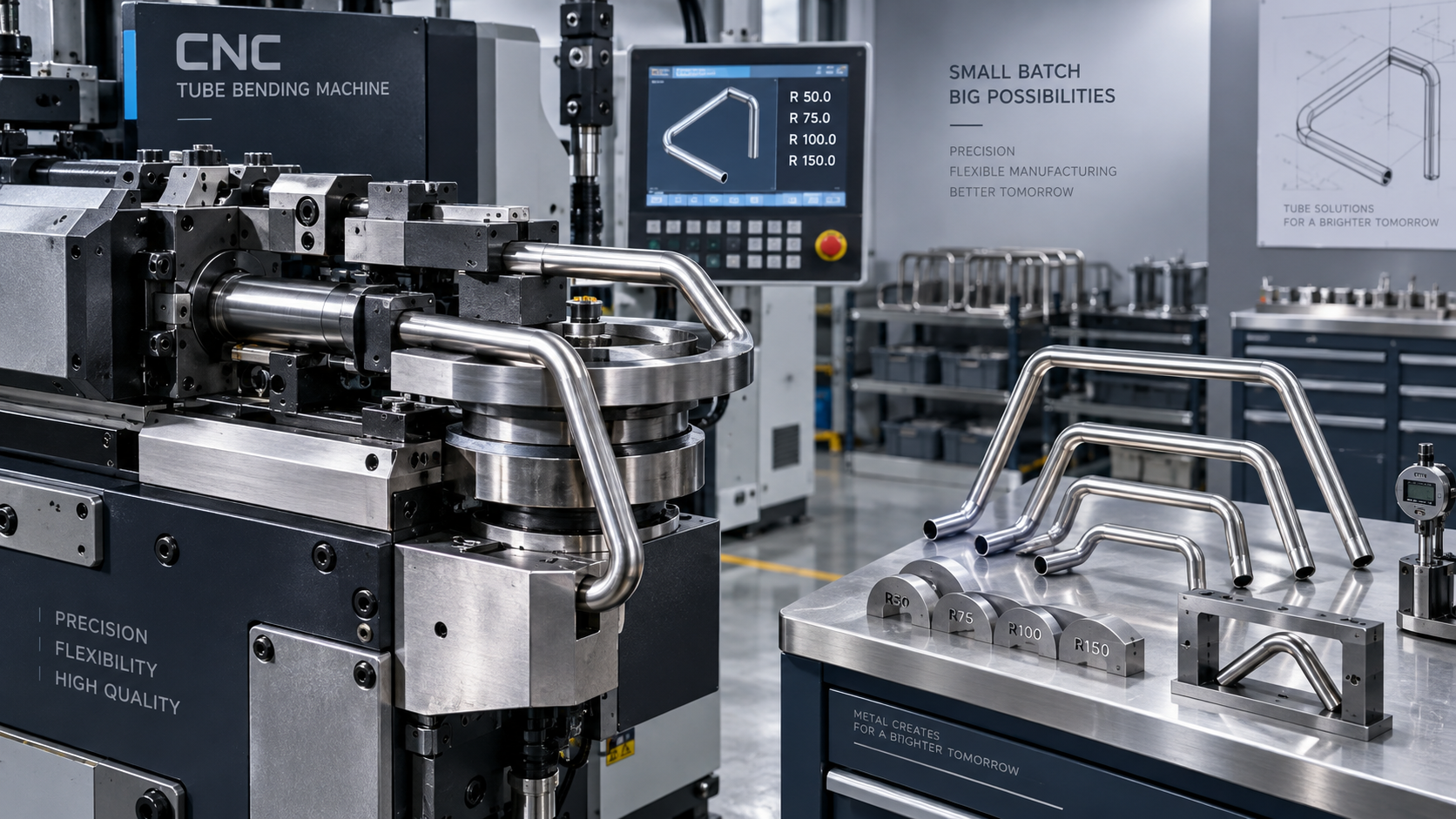
When a Tube Bender Is the Right Choice for Small-Batch Production
For project managers handling limited production runs, choosing the right equipment can determine whether a job stays on schedule and within budget. A tube bender is often the practical choice when flexibility, repeatable accuracy, and reduced setup complexity matter more than high-volume automation. Understanding when tube bending equipment delivers the strongest return helps teams improve workflow efficiency, maintain quality standards, and respond confidently to changing project requirements.
Small-batch work creates a different decision environment from stable, high-volume production. The drawing may change after a customer review. One project may require stainless handrails, while the next involves carbon-steel frames or aluminum components. Quantities may be modest, but tolerances, appearance, weld fit-up, and delivery commitments can still be demanding. In these conditions, the lowest cost per part is not always the most useful measure. The ability to move from drawing to approved first piece without excessive tooling or outsourced dependency is often more valuable.
The real question is not volume alone
It is tempting to define a tube bender as equipment for low or medium output and a dedicated automated line as equipment for large output. In practice, project complexity matters just as much as quantity. A run of a few hundred identical parts may justify specialized tooling if the design is frozen and repeat orders are likely. Conversely, a run of several thousand pieces may still benefit from a flexible bending machine if it includes many different radii, frequent specification changes, or several tube diameters.
For small-batch production, a tube bender is usually the right choice when the team needs to make controlled trade-offs between preparation time and cycle time. It can be particularly suitable for fabrication of equipment frames, vehicle-related assemblies, furniture structures, fitness equipment, process skids, protective guards, agricultural machinery parts, and architectural or industrial railing components. These jobs commonly have a mixture of straight lengths, simple radii, and variable end conditions rather than a single unchanging geometry.
The key is to look beyond the phrase “small batch.” A project with 20 complex tube assemblies may need more planning than a project with 500 simple bends. Material condition, bend radius, finishing requirements, welding sequence, and inspection criteria all influence whether bending in-house is sensible.
Where flexible bending has an operational advantage
A well-matched tube bending machine allows a project team to control the critical path rather than waiting for outside processing. That does not mean every tube should be bent internally. It means the operation should be brought closer to the project when response speed, revision handling, or fit-up verification are likely to affect delivery.
Consider a fabricated assembly that includes bent tubing, machined connection points, and welded plate brackets. If the tube geometry is outsourced, a minor change to the bracket position can trigger a new request, shipping delay, and another inspection cycle. With an appropriate tube bender on the shop floor, the team can revise the bend program or setup, produce a sample, check it against the mating components, and release the batch with less disruption. This is especially relevant when prototypes evolve into short production runs before the final design is fully standardized.
Repeatability also matters. Manual bending may be adequate for basic repair work or a few non-critical pieces, but it becomes difficult to manage when angle consistency, rotation between bends, or dimensional interchangeability affects downstream welding. CNC and semi-automatic configurations can offer a more controlled process for recurring parts, while still avoiding the commitment of a highly dedicated production cell. The appropriate level of automation should follow the part family and the operator’s workflow, not a general assumption that more automation is always better.
What should be checked before selecting a tube bender
A bending machine should be selected from actual part data, not only from the outside diameter shown on a drawing. Project managers do not need to become bending specialists, but they should ensure that the production review includes a few practical questions early enough to prevent surprises.
- Tube profile and dimensions: Confirm whether the work is round tube, square tube, rectangular tube, or pipe, and identify the outside dimensions and wall thickness. Machines, dies, and support tooling must suit the actual profile.
- Material behavior: Carbon steel, stainless steel, aluminum, and other alloys respond differently during bending. Material grade, temper, and wall thickness can influence springback, surface marking, and the risk of wrinkling or flattening.
- Centerline radius: Tight-radius bends generally require more careful tooling and process control. A radius that looks acceptable in a 3D model may not be practical without distortion on the chosen tube.
- Part geometry: Measure the distance from tube ends to the first bend, the spacing between successive bends, and the required rotation. Interference between the formed part and machine tooling can be as limiting as bending force.
- Acceptance criteria: Establish what is actually critical: bend angle, end position, ovality, surface appearance, or joint fit-up. The inspection approach should reflect those requirements.
This review often exposes issues that are inexpensive to solve on paper but costly once production begins. For example, allowing a slightly larger bend radius may reduce tooling difficulty. Repositioning a welded tab away from the bend tangent may improve assembly access. Specifying realistic measurement datums can also prevent disputes between the forming operation and the welding team.
A good bend is more than the correct angle
Project schedules can be affected by quality problems that do not appear during a quick visual check. A tube may reach the nominal angle while still having excessive flattening, wrinkles on the inside radius, marks on a visible surface, or variation in the straight lengths after bending. Those conditions become more serious if the component must be welded into a fixture, sealed, powder coated, or used in a visible finished product.
The first-piece approval process should therefore include the characteristics that matter to the next operation. If a bent tube joins laser-cut plates, checking it against the actual bracket pattern is usually more meaningful than checking one isolated dimension. If the tube will carry fluid or cable, internal deformation may require closer review. Where appearance is important, the team should agree in advance on permissible tooling marks and handling protection.
Springback deserves particular attention. After the bending force is released, the material recovers slightly, so the machine may need to overbend to achieve the required finished angle. The amount depends on material and geometry. It should be established through setup trials and documented in the work instructions rather than estimated differently by each operator. For repeat small batches, retaining approved programs, die information, and inspection records can shorten future preparation without treating every job as a completely new development.
When a tube bender is not the best answer
A tube bender is not a cure for every formed-metal requirement. Large-radius curves in wide sheet or plate are generally better addressed by rolling or press forming. Heavy structural members may call for specialized section bending equipment. Extremely thin decorative tubing can require careful surface protection and process trials that alter the economics of a short run. Parts with very demanding internal cleanliness or special aerospace, pressure, or safety requirements may need procedures and verification beyond a standard fabrication setup.
There is also a threshold at which a dedicated high-output solution becomes more logical. If the design is stable, demand is predictable, and a single component dominates production time, a project team should compare labor, tooling life, handling, and throughput against more automated alternatives. The conclusion should be based on the full production picture, including changeover and maintenance, rather than on bending speed alone.
Another common mistake is to force a tube operation into a project that is mainly plate fabrication. The better approach is to plan the fabrication route as one connected system. Bent tubes may need precise plates with beveled edges before robotic or manual welding. For work involving carbon steel, stainless steel, or aluminum plates, an edge milling process can prepare consistent weld bevels and reduce secondary grinding. Equipment such as a Turn Type Plate Edge Milling Machine may be relevant when the project includes long plates or repeatable groove preparation alongside bent-tube assemblies. Standard versions are designed for plate thicknesses from 6 to 80 mm, while heavy-duty non-pressure beam versions can handle 6 to 400 mm; the correct application still depends on joint design and the overall fabrication route.
Planning the work cell around the bending operation
The machine itself is only one part of the decision. Small-batch efficiency often comes from the surrounding workflow: how material is cut, identified, staged, bent, inspected, and transferred to welding or assembly. A capable bender can still create delays if operators spend too much time searching for dies, measuring unmarked blanks, or moving long tubes through a congested area.
A practical work cell usually benefits from organized tooling storage, clear job travelers, length stops or verified cut blanks, and a first-off inspection point close to the machine. For longer workpieces, safe support during loading and unloading deserves attention. The formed component can swing unexpectedly as it rotates, and both material handling and guard arrangements should be considered before production begins. Safety expectations and electrical or conformity requirements also vary by destination market, so they should be clarified when equipment specifications are being finalized.
Maintenance planning is similarly important for intermittent work. Small-batch shops may leave a machine idle between projects, then expect immediate output when a new order arrives. Routine checks of lubrication, clamps, hydraulic or electrical systems where applicable, die condition, and machine calibration help avoid avoidable startup problems. The goal is not excessive administration; it is to ensure that a previously approved process remains reproducible when the job returns months later.
Choosing with the next project in mind
For project-based manufacturers, equipment should be judged by the range of work it can absorb without creating a new bottleneck. A tube bender earns its place when it allows the team to respond to variable drawings, control first-piece quality, reduce reliance on repeated outsourcing, and produce consistent parts across limited runs. It is less compelling when the work is highly standardized at volumes that justify a dedicated automated route, or when the geometry and material demand another forming process.
Wuxi Samgins International Trade Co.,Ltd, established in 2012 in Wuxi, Jiangsu Province, supplies equipment across tube bending, welding, CNC cutting, machine tools, laser processing, plate handling, and H-beam production applications. Its location, around 30 minutes from Shanghai by high-speed rail, supports practical coordination for equipment and project discussions. Production and design are organized in accordance with the ISO9001 quality system and EU CE standards, while equipment has been supplied to markets in Southeast Asia, Europe, the Americas, and Oceania.
Before committing to a machine, provide the supplier with representative drawings, tube material and dimensions, minimum bend radius, expected batch sizes, required accuracy, and the downstream process. That information makes it possible to assess not only whether a tube can be bent, but whether it can be bent reliably within the realities of the project schedule.
search
Products Navigation
Send Us A Message